ACT Developer Licensing: What Started in October 2026
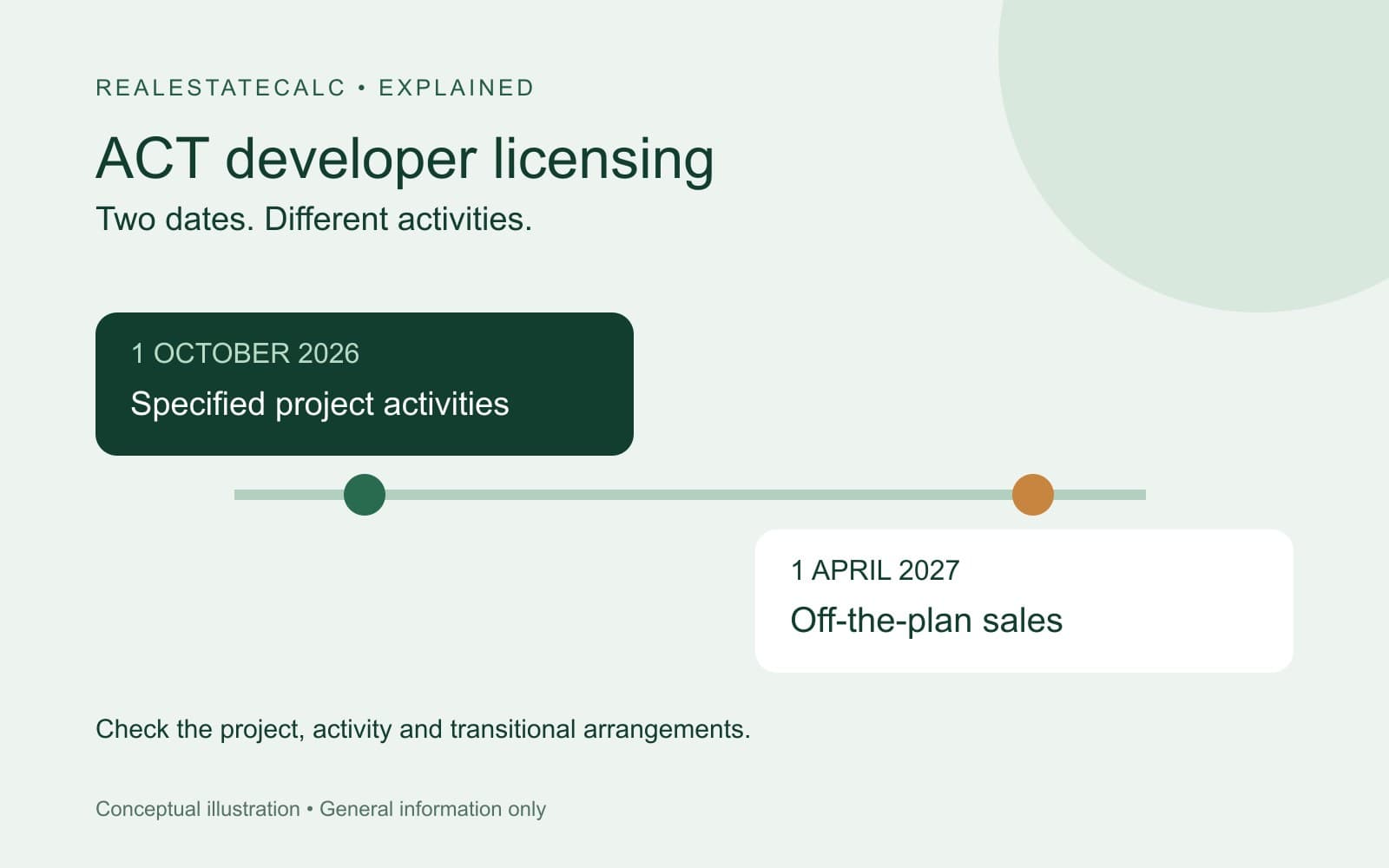
ACT developer licensing requirements started for specified development and building activities on 1 October. Off-the-plan sales have a separate April 2027 start.
Try the Property Purchase Cost Calculator
Run the numbers while you read and see how the concepts apply to your situation.
What changed
From 1 October 2026, ACT property developer licensing became mandatory for specified development and building activities involving residential projects with three or more dwellings. The ACT Government's current guidance gives 1 April 2027 as the separate start for the requirement to hold a developer licence to sell or advertise residential property off the plan.
That distinction matters to anyone reading an older announcement or comparing a new Canberra apartment with an established home. The dates refer to different activities. Source: ACT property developers licensing scheme.
Check the activity as well as the date
The current ACT guidance identifies development applications and specified building approval, construction and occupancy stages within the October requirements. It excludes single dwellings and dual occupancies from this scheme. Transitional arrangements can affect projects already underway, so an October date alone does not establish a particular project's obligations.
The ACT Legislation Register records the Property Developers Act 2024 as partially commenced, with a current republication effective 1 October 2026. The September commencement notice is also available there. This article reports the current official guidance; it does not interpret the legislation for an individual purchase.
A buyer's document record
For a project under consideration, keep an enquiry record with four separate entries:
| Entry | What to request | Why keep it separate? |
|---|---|---|
| Entity | The legal name and role of the developer | A project brand may not identify the contracting entity |
| Licence | Licence details and the date checked | A sales statement is not a saved record of the check |
| Project stage | Relevant application, approval and proposed completion dates | Each date answers a different question |
| Professional response | Written advice about the actual documents and any unresolved issue | A general article cannot assess a specific transaction |
This is our own information-organising checklist, not an official form. Give the documents to the relevant authority or your solicitor or conveyancer where the position is unclear. A licence check does not replace contract review, technical inspections or an assessment of the actual property.
Our off-the-plan versus established property guide discusses the broader comparison. The pre-settlement inspection checklist addresses a later condition check.
Worked example: an unresolved date stays unresolved
An invented buyer is budgeting for a new apartment while paying $650 a week in rent. They test what another six weeks in their current rental would cost: $650 x 6 = $3,900 in gross rent payments.
This is an arithmetic sensitivity check, not a prediction that licensing will delay a development. It also excludes any ownership costs that might start if the buyer moved sooner. A licensing milestone supplies neither a personal move-in date nor a complete estimate of the cost of waiting.
Keep an unconfirmed handover date marked as unconfirmed. The Rent-to-Income Ratio Calculator can compare entered rent and income, but cannot confirm housing availability or a project's delivery schedule.
What changes in our calculators?
This licensing update does not change a stamp duty rate, mortgage repayment formula or published calculator setting. Use the Property Purchase Cost Calculator to organise indicative acquisition costs separately from project checks. It cannot confirm a licence, assess building quality or establish which transitional rules apply.
Sources and limitations
The current ACT scheme guidance, legislation register and commencement-notice record were checked on 13 October 2026. Older material can describe earlier rollout plans; use the current official guidance and obtain project-specific advice. No particular developer or project was assessed for this article.
General information only, not legal, planning, building, financial, credit, tax or investment advice. This is not a compliance determination, approval, building guarantee or recommendation to purchase. Confirm the current requirements and actual documents with the relevant authority and qualified professionals.
Last updated: 13 October 2026.
RealEstateCalc Editorial
Property & Finance ResearchThe RealEstateCalc editorial team researches and writes about Australian property, finance, and tax topics. All content is fact-checked against official sources including the ATO, state revenue offices, ASIC Moneysmart, and the RBA.
Related Calculators

Property Purchase Cost Calculator
Estimate the total upfront costs of buying property in Australia, including stamp duty, government fees, legal costs, inspections, insurance, and moving expenses.
PropertyRent-to-Income Ratio Calculator Australia
Estimate what share of gross household or individual income is used by rent, with annualised amounts and a clear explanation of the limits.
PropertyRelated Articles
Off-the-Plan vs Established Property: Pros, Cons & Financial Comparison
Compare off-the-plan and established property costs, settlement cash gaps, inspections and duty evidence with practical Australian examples.
Pre-Settlement Inspection Checklist for Australian Property Buyers
A practical final inspection checklist for Australian property buyers: what to compare with the contract, what to test, how to record problems and what the inspection cannot resolve.
Ready to try the Property Purchase Cost Calculator?
Use the calculator to model an indicative estimate from the assumptions you enter.
What moved in Australian property this week — in your inbox Sunday.
RBA decisions, clearance rates, policy shifts and the calculators that dropped. Two-minute read, no filler.
Free. No spam. Unsubscribe anytime.