NSW Social Housing Energy Upgrades: January 2027 Start Announced
The 13 September announcement adds $145.3m for NSW social housing energy upgrades. Check the delivery dates and keep projected savings out of current budgets.
Try the Rent-to-Income Ratio Calculator Australia
Run the numbers while you read and see how the concepts apply to your situation.
What changed on 13 September
The Australian Government announced $145.3 million for energy upgrades to an additional 13,500 NSW social housing properties on 13 September 2026. Work under the expanded Social Housing Energy Performance Initiative is scheduled to start in January 2027. Housing providers will identify and prioritise eligible properties. The announcement is not an individual rebate offer. Source: DCCEEW ministerial release.
For a tenant, the immediate task is to confirm the property's place in the provider's program. A statewide announcement does not establish an installation date or bill saving for an individual address.
Keep completed work separate from future upgrades
The release describes several stages of the NSW program:
| Measure | Figure or date in the announcement |
|---|---|
| Additional properties in the expansion | 13,500 |
| Start of expanded works | January 2027 |
| NSW properties already upgraded under the original program | More than 15,000 |
| NSW properties expected to be upgraded by the expanded program's end | Around 37,500 by 2030 |
The last row is the overall target, not a further 37,500 homes to add to the preceding figures. These are improvements to existing social housing, not new dwellings added to the housing supply.
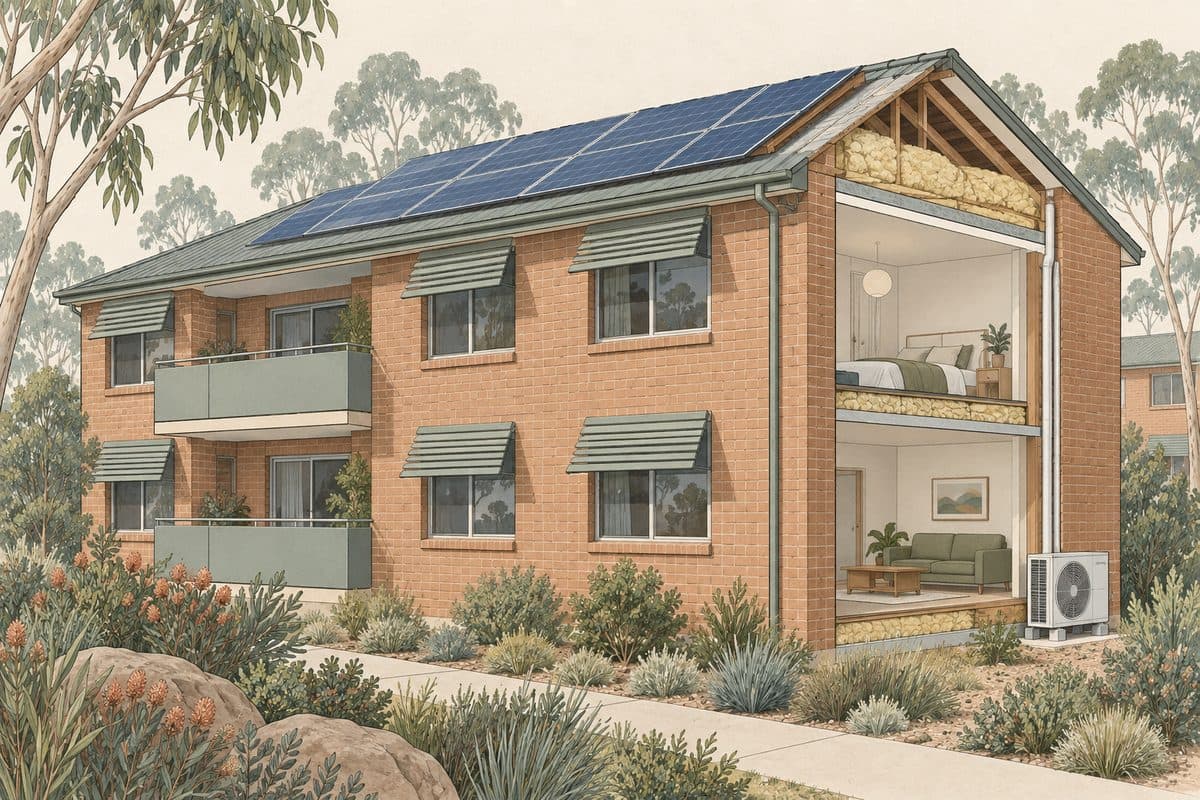
Possible works include solar and batteries, reverse-cycle air conditioning, heat pump hot water, insulation and draught proofing. The release does not assign a package to every property.
What to ask before changing a household budget
Useful questions for the housing provider include:
- Has this address been selected, or is selection still pending?
- Which works are proposed, and when will the provider confirm an appointment?
- What access is needed, and will services be interrupted during installation?
- Who explains the controls, operating instructions and fault-reporting process?
- Which bills will the resident continue to pay, and how should a problem after installation be reported?
Keep the provider's written information with the tenancy documents. A contractor's proposed visit, a completed installation and a lower bill are separate events. Do not treat a general news article as authority to arrange or approve works on the provider's property.
Worked example: compare like billing periods
The following figures are invented to show the arithmetic, not predicted SHEPI savings. Suppose a household's electricity bill is $360 for a 90-day period before an upgrade and $300 for a later 90-day period. The observed bill difference is $60, or about $0.67 a day.
That difference alone does not show how much the equipment saved. The periods may have different weather, tariffs, household occupancy or appliance use. Record those changes before attributing the whole reduction to the upgrade. If the two bills covered 90 and 100 days, compare daily amounts first rather than subtracting the totals.
A separate rent budget also needs its own scope. Weekly rent of $300 and gross weekly income of $1,200 produce a 25% rent-to-income ratio. A change in the electricity bill does not change that ratio because neither input is electricity spending. To understand money left over, list utilities, tax and other living costs separately. Read the rent and income explainer for the difference between a simple ratio and a household budget.
Separate this program from other NSW energy schemes
The September NSW ESS and PDRS rule update concerns certificate schemes and their implementation rules. This social housing announcement concerns a provider-delivered upgrade program. Do not transfer a minimum payment, product condition or provider process from one scheme into the other without checking the applicable documents.
No RealEstateCalc mortgage, rent, duty or tax formula changes follow from this announcement. The site has no property-level installation schedule or verified household energy-use model to turn the funding amount into a personal saving estimate.
Sources and limitations
- DCCEEW: Lower bills and more comfortable homes for NSW social housing residents, published 13 September 2026, checked 16 September 2026. This is an announcement of funding and delivery plans; January 2027 is the announced start of expanded works.
- The worked example is original hypothetical arithmetic. It does not estimate an individual property's energy performance or establish access to the program.
The accompanying artwork is conceptual, not a photograph of an upgraded property.
General information only. This is not an eligibility determination, rebate offer, energy saving guarantee, product recommendation, financial, legal, tax or credit advice. Confirm the property's program details with the housing provider and seek appropriately qualified advice for personal circumstances.
Last updated: 16 September 2026.
Frequently asked questions
When will the expanded NSW social housing energy works start?
The 13 September 2026 announcement schedules expanded works from January 2027. It does not give an installation date for every property.
Does the announcement guarantee an upgrade for my home?
No. Housing providers will identify and prioritise eligible properties. Confirm the details for a particular address with its provider.
RealEstateCalc Editorial
Property & Finance ResearchThe RealEstateCalc editorial team researches and writes about Australian property, finance, and tax topics. All content is fact-checked against official sources including the ATO, state revenue offices, ASIC Moneysmart, and the RBA.
Related Calculators

Related Articles
NSW Energy Upgrade Rules Change From 7 September 2026
New NSW Energy Savings Scheme and Peak Demand Reduction Scheme rules apply from 7 September 2026. Check air-conditioner and battery quote requirements.
Young Private Renters Aged 23 to 24 Spent 47% of Income on Rent
New AIFS research found private renters aged 23 to 24 spent 47% of gross income on rent on average in 2023-24. See the sample, method and limits.
Ready to try the Rent-to-Income Ratio Calculator Australia?
Use the calculator to model an indicative estimate from the assumptions you enter.
What moved in Australian property this week — in your inbox Sunday.
RBA decisions, clearance rates, policy shifts and the calculators that dropped. Two-minute read, no filler.
Free. No spam. Unsubscribe anytime.