NSW Strata Unit Entitlements: A Worked Levy-Share Example
Translate an assumed NSW strata levy total into a lot share, with separate administrative and capital works amounts, quarterly examples and checks against the actual notice.
Try the Mortgage Repayment Calculator
Run the numbers while you read and see how the concepts apply to your situation.
Short answer
For a simple proportionate allocation, multiply the amount being raised by your lot's unit entitlement divided by the scheme's total unit entitlements. Use confirmed strata records and reconcile the result with the levy notice. This worksheet illustrates arithmetic; it does not decide a scheme's legal allocation or create an amount payable.
Keep levies separate from the loan repayment shown by the Mortgage Repayment Calculator. Both may affect an owner's cash budget.
Get the inputs from the records
NSW Government strata finance guidance explains that owners' levy contributions are based on unit entitlement, which can be found on the strata plan. It distinguishes administrative and capital works funds and says levies are normally paid quarterly. Different scheme types can have different rules.
Ask for the current levy resolution or schedule, the relevant plan information and the notice for your lot. Do not substitute the number of apartments for total unit entitlements, or use your purchase price as your entitlement.
| Input | Illustrative value | What to confirm |
|---|---|---|
| Total unit entitlements | 1,000 | Correct scheme and current schedule |
| Your lot's entitlement | 65 | Correct lot, including separately identified lots if relevant |
| Administrative contributions to be raised | $80,000 a year | Levy total, not simply gross spending |
| Capital works contributions to be raised | $40,000 a year | Separate fund and matching period |
| Instalments | Four equal amounts | Actual schedule may differ |
All numbers below are invented for explanation. They are not average NSW levies or a statement about an actual building.
Work through the two funds separately
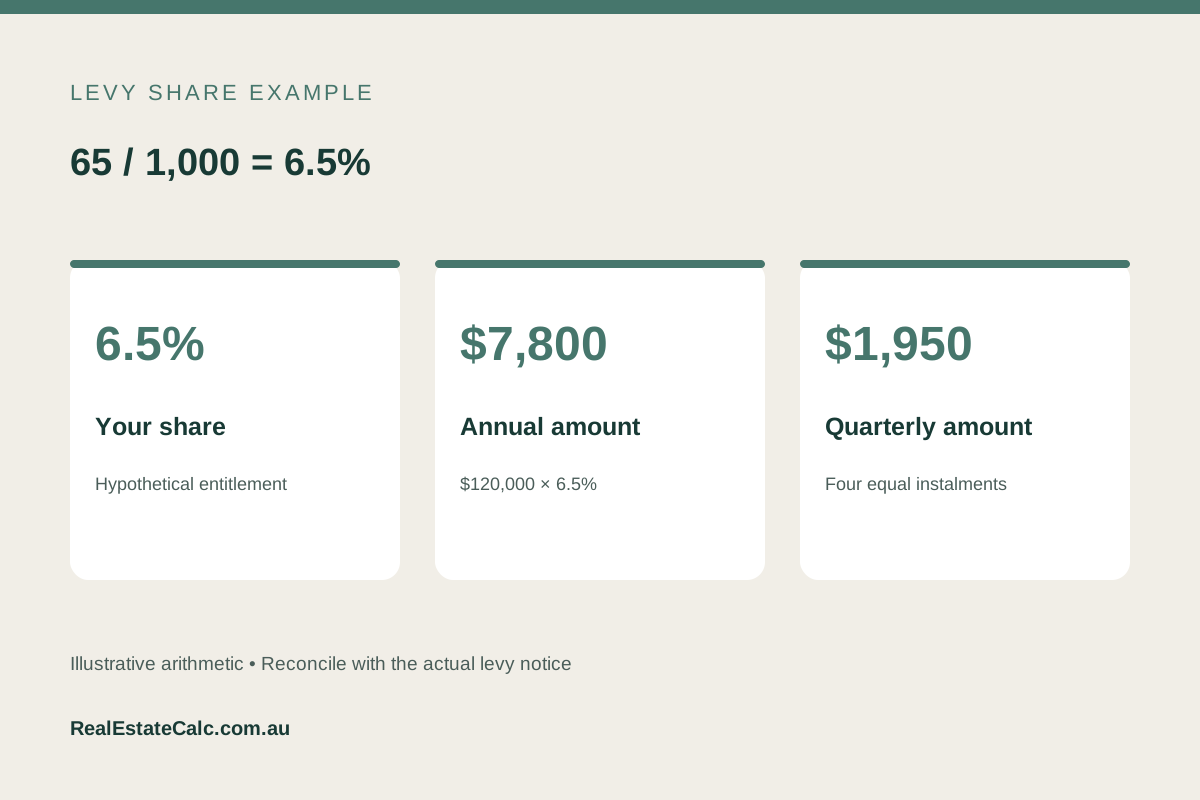
The assumed share is 65 ÷ 1,000 = 6.5%.
| Contribution | Scheme amount | Assumed lot share | Each of four equal instalments |
|---|---|---|---|
| Administrative | $80,000 | $5,200 | $1,300 |
| Capital works | $40,000 | $2,600 | $650 |
| Total | $120,000 | $7,800 | $1,950 |
The annual total is $120,000 × 0.065 = $7,800. Dividing by four gives $1,950. Dividing by 12 instead gives $650 a month for budgeting, but it does not turn a quarterly bill into monthly instalments.
If the next payment is due before three months of savings have accumulated, a $650 monthly transfer alone may not cover it. Use the actual due dates and existing cash balance.
Why dividing by the apartment count can mislead
Suppose this hypothetical scheme has 20 lots. Dividing $120,000 by 20 gives $6,000 each, which assumes an equal 5% share. Our example lot has a 6.5% share, so that shortcut understates its illustrated annual contribution by $1,800.
The comparison does not establish that the entitlement is fair, current or legally correct. A discrepancy is a reason to ask for the calculation and records, not to replace a levy notice with this worksheet.
A spending budget is not always the amount to raise
Consider a separate hypothetical administrative budget with $90,000 of spending and $10,000 of other confirmed funding. If the approved contributions to be raised are $80,000, applying 6.5% to $90,000 would produce $5,850 instead of $5,200: a $650 difference.
This is an arithmetic illustration, not permission to use reserves or reduce levies. Ask which number is the approved contribution total. An expense forecast, bank balance and levy resolution describe different things.
Reconcile before using the result
Check the financial year, fund, lot number, entitlement schedule, instalment dates and rounding. Separate arrears, credits, interest, special levies or other adjustments from the regular contribution. Mark unexplained differences as unresolved rather than forcing the worksheet to match.
If the notice includes a special levy, use the special levy cash-flow worksheet to map its timing. If you are buying, add verified upfront costs using the Property Purchase Cost Calculator and ask your conveyancer about settlement adjustments. This article does not allocate a cost between buyer and seller.
Common questions
Does a lower levy mean a cheaper building to own? The current levy alone does not show future repair needs or the completeness of a budget. Review the supporting records before treating it as a lasting cost.
Can I apply this to every Australian scheme? No. This is a NSW-focused arithmetic example using a simple proportionate allocation. Different jurisdictions, scheme types and specific charges need their own checks.
Does the October announcement change these figures? No saving is assumed. The October strata bill update separates parliamentary passage from commencement and building-specific costs.
Source and limitations
NSW Government finance guidance linked above checked 19 October 2026. Source material supports the general entitlement and fund explanation; the tables and calculations are original hypothetical examples. They exclude tax treatment, disputes and exceptions to a simple allocation.
General information only, not financial, legal, tax, credit or investment advice. Confirm the current scheme records, approved amounts and payment obligations with the strata manager or owners corporation, and obtain qualified advice for a dispute. This is not an official levy assessment or a recommendation to buy.
Last updated: 19 October 2026.
RealEstateCalc Editorial
Property & Finance ResearchThe RealEstateCalc editorial team researches and writes about Australian property, finance, and tax topics. All content is fact-checked against official sources including the ATO, state revenue offices, ASIC Moneysmart, and the RBA.
Related Calculators

Mortgage Repayment Calculator
Calculate mortgage payments, total interest, and view an amortisation schedule for your home loan.
FinanceProperty Purchase Cost Calculator
Estimate the total upfront costs of buying property in Australia, including stamp duty, government fees, legal costs, inspections, insurance, and moving expenses.
PropertyRelated Articles
Strata Special Levy Budget: Check the Due Dates, Not Just the Total
Build a cash-flow worksheet for a known strata special levy. Separate regular levies, one-off instalments and available savings, with a worked example of a timing shortfall.
NSW Fourth Strata Bill Passes: Check Commencement Before Changing Your Budget
On 16 October 2026, NSW announced that another strata bill had passed Parliament. Separate the announcement from commencement dates and confirmed building costs.
Ready to try the Mortgage Repayment Calculator?
Use the calculator to model an indicative estimate from the assumptions you enter.
What moved in Australian property this week — in your inbox Sunday.
RBA decisions, clearance rates, policy shifts and the calculators that dropped. Two-minute read, no filler.
Free. No spam. Unsubscribe anytime.