Try the Mortgage Repayment Calculator
Run the numbers while you read and see how the concepts apply to your situation.
Short answer
A lower annual premium can leave more money in the regular budget while a higher excess increases the amount payable for a claim. Compare both amounts. The premium saving alone does not show whether a policy suits your circumstances.
This worksheet isolates the arithmetic using invented quotes. It does not rate insurers, estimate the likelihood of a claim or recommend changing cover. Start with the annual home bills budget guide if you first need to convert a renewal amount into a monthly allowance.
Record the cover before comparing the price
ASIC's Moneysmart home insurance guidance explains premiums and excesses and directs readers to compare coverage, exclusions and limits. It points to the Key Fact Sheet and product disclosure statement (PDS) for policy information.
Use this original record for two actual quotes. Leave an unanswered question visible rather than assuming the policies match.
| Field | Quote A | Quote B |
|---|---|---|
| Quote date and cover period | Record | Record |
| Total annual premium, including quoted charges | Record | Record |
| Total if paid by instalments | Check | Check |
| Building and contents sums insured | Record separately | Record separately |
| Excess for the event being compared | Confirm | Confirm |
| Other applicable excesses | Ask insurer | Ask insurer |
| Cover, exclusions, limits and optional extras | List differences | List differences |
| Documents and unanswered questions | Save references | Save references |
If cover differs, the price difference is not solely the price of changing the excess. The worksheet cannot put a value on the missing or additional protection.
Worked example: two invented quotes
Assume, solely for this arithmetic example, that the cover and all other charges match and that each hypothetical accepted claim has the single listed excess. The quotes are not market prices.
| Item | Quote A | Quote B |
|---|---|---|
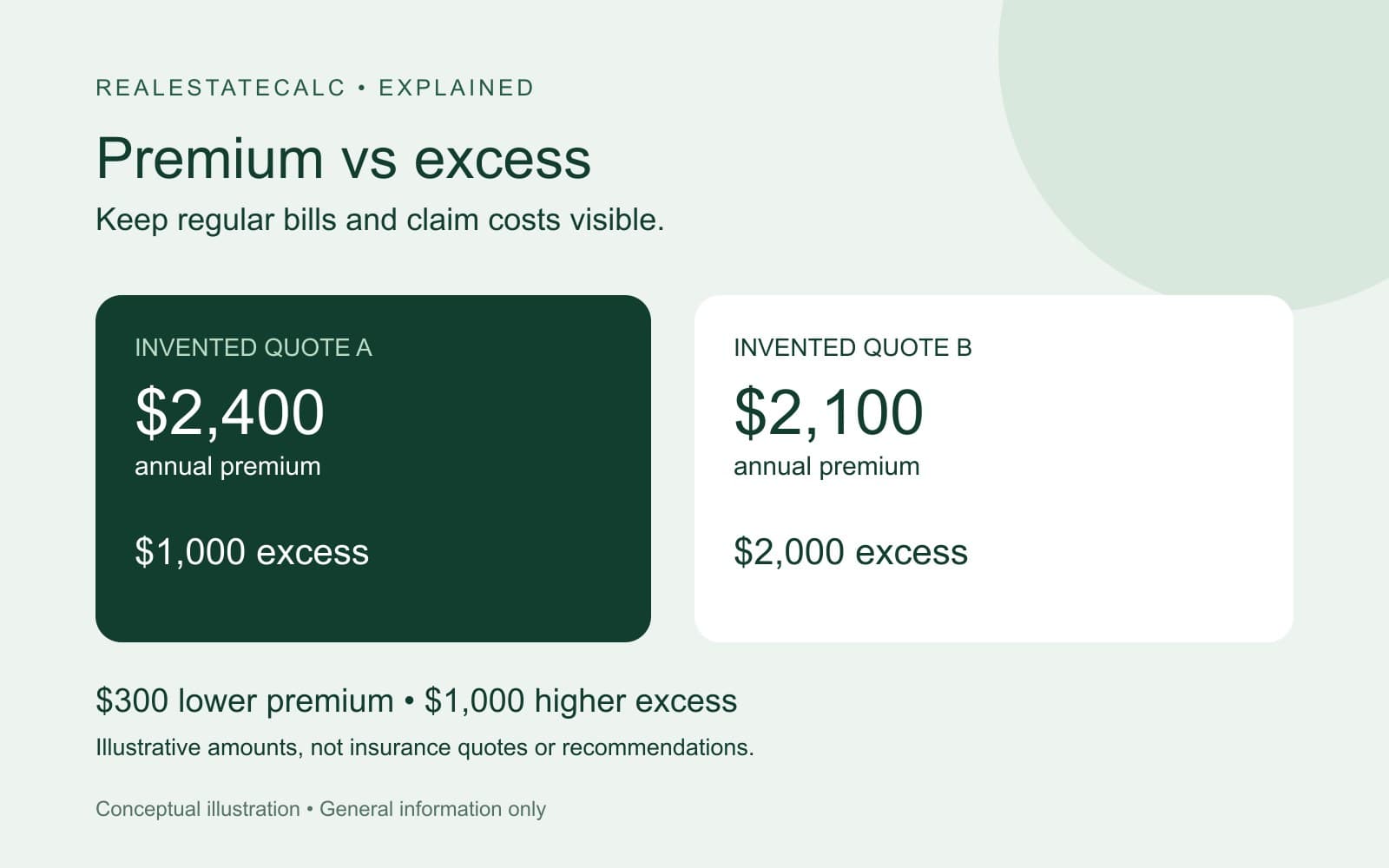
| Annual premium | $2,400 | $2,100 |
| Excess per assumed claim | $1,000 | $2,000 |
| Monthly premium allowance | $200 | $175 |
Quote B's premium is $300 a year lower, or $25 a month. Its excess is $1,000 higher for each claim in this simplified example.
For a one-year comparison, add the annual premium to the assumed number of claims multiplied by that quote's excess:
| Illustrative year | Quote A: premium plus excesses | Quote B: premium plus excesses | Difference |
|---|---|---|---|
| No claims | $2,400 | $2,100 | B is $300 lower |
| One claim | $3,400 | $4,100 | B is $700 higher |
| Two claims | $4,400 | $6,100 | B is $1,700 higher |
These totals are not the household's total cost of damage. They exclude uninsured losses, amounts above limits, additional excesses and any other payments. Actual claims can involve different terms, and a claimed event is not necessarily covered.
Why the savings-to-excess ratio has limits
Dividing the extra $1,000 excess by the $300 annual premium saving gives 3.33 years. That means 3.33 years of unchanged premium savings would equal one extra excess in this example. At three full years the savings would be $900; at four they would be $1,200.
This ratio is not a probability or a recommended holding period. A claim could happen before the first year's saving has accumulated. Premiums, excesses and terms can change at renewal, and multiple claims change the arithmetic. If the premium saving is zero or negative, this particular savings ratio has no useful positive payback interpretation.
Keep the cash question separate
An invented household has $1,500 available for a possible excess. Against the example $2,000 excess, its cash shortfall would be $500. The lower $175 monthly premium allowance does not fill that gap immediately.
That is only a comparison of two entered amounts, not an assessment of how much emergency money a household needs. The mortgage buffer worksheet covers repayment reserves. Do not count the same cash as fully available for several different expenses at once.
The Mortgage Repayment Calculator can estimate the loan payment alongside these ownership expenses. It does not include an insurance policy assessment. For an initial purchase budget, use the Property Purchase Cost Calculator and record ongoing insurance separately.
Common questions
Does raising the excess always reduce the premium?
Use actual quotes to find the difference. Moneysmart describes a possible premium reduction, not a guaranteed saving of a particular size. Check the terms rather than extrapolating from this example.
Does the cheapest scenario identify the right policy?
No. The table answers a narrow arithmetic question under invented assumptions. Cover, exclusions, cash available and individual circumstances remain outside it. Ask the insurer to explain unclear terms and speak with a licensed professional where advice is needed.
Sources and limitations
Moneysmart: Choosing home insurance, updated 2 October 2026, was checked on 13 October 2026. The worksheet, quotes and calculations are our own hypothetical examples. No insurance products, live prices or claim probabilities were compared.
General information and indicative budgeting only, not personal financial, insurance, legal, tax or credit advice, a product recommendation, quote or assurance that a claim will be paid. Confirm policy wording and actual amounts with the provider.
Last updated: 13 October 2026.
Frequently asked questions
Does a lower premium mean an insurance policy costs less in every scenario?
No. A higher excess can reverse the premium saving when a claim occurs. Compare actual coverage and terms as well as the illustrative cash amounts.
Does the savings-to-excess ratio predict when a claim will happen?
No. It only divides an extra excess by an assumed annual premium saving. It does not estimate claim probability, future prices or a suitable insurance choice.
RealEstateCalc Editorial
Property & Finance ResearchThe RealEstateCalc editorial team researches and writes about Australian property, finance, and tax topics. All content is fact-checked against official sources including the ATO, state revenue offices, ASIC Moneysmart, and the RBA.
Related Calculators

Mortgage Repayment Calculator
Calculate mortgage payments, total interest, and view an amortisation schedule for your home loan.
FinanceProperty Purchase Cost Calculator
Estimate the total upfront costs of buying property in Australia, including stamp duty, government fees, legal costs, inspections, insurance, and moving expenses.
PropertyRelated Articles
Annual and Quarterly Home Bills: Build a Monthly Allowance
Convert annual and quarterly home bills into a monthly allowance, then check cash available before each due date. Includes an Australian dollar worked worksheet.
How to Calculate a Mortgage Buffer in Australia
Calculate months of mortgage and essential-expense cover using accessible cash, offset savings and confirmed redraw, with a worked Australian example and practical limitations.
Ready to try the Mortgage Repayment Calculator?
Use the calculator to model an indicative estimate from the assumptions you enter.
What moved in Australian property this week — in your inbox Sunday.
RBA decisions, clearance rates, policy shifts and the calculators that dropped. Two-minute read, no filler.
Free. No spam. Unsubscribe anytime.