Annual and Quarterly Home Bills: Build a Monthly Allowance
Convert annual and quarterly home bills into a monthly allowance, then check cash available before each due date. Includes an Australian dollar worked worksheet.
Try the Mortgage Repayment Calculator
Run the numbers while you read and see how the concepts apply to your situation.
Short answer
For an annual bill, divide the expected annual amount by 12. For a quarterly bill, multiply the expected quarterly amount by four, then divide by 12. A monthly allowance spreads a cost across the year; it does not prove the money will be available by the due date.
Keep the mortgage payment in a separate row. The Mortgage Repayment Calculator estimates loan repayments, while this worksheet organises other recurring home expenses.
ASIC Moneysmart's budgeting guidance recommends recording expenses, including irregular and annual bills, and checking payment timing. The worksheet below applies that approach to a small set of home costs.
A worked home-bills allowance
These figures are invented to show the method. They are not average Australian bills, quotes, tax assessments or suggested spending levels. Assume the quarterly amounts repeat unchanged for four quarters and that all charges are counted once.
| Item | Entered amount and frequency | Annual equivalent | Monthly allowance |
|---|---|---|---|
| Council rates | $600 per quarter | $2,400 | $200 |
| Water charges | $300 per quarter | $1,200 | $100 |
| Home insurance | $2,300 per year | $2,300 | $191.67 |
| Electricity | $450 per quarter | $1,800 | $150 |
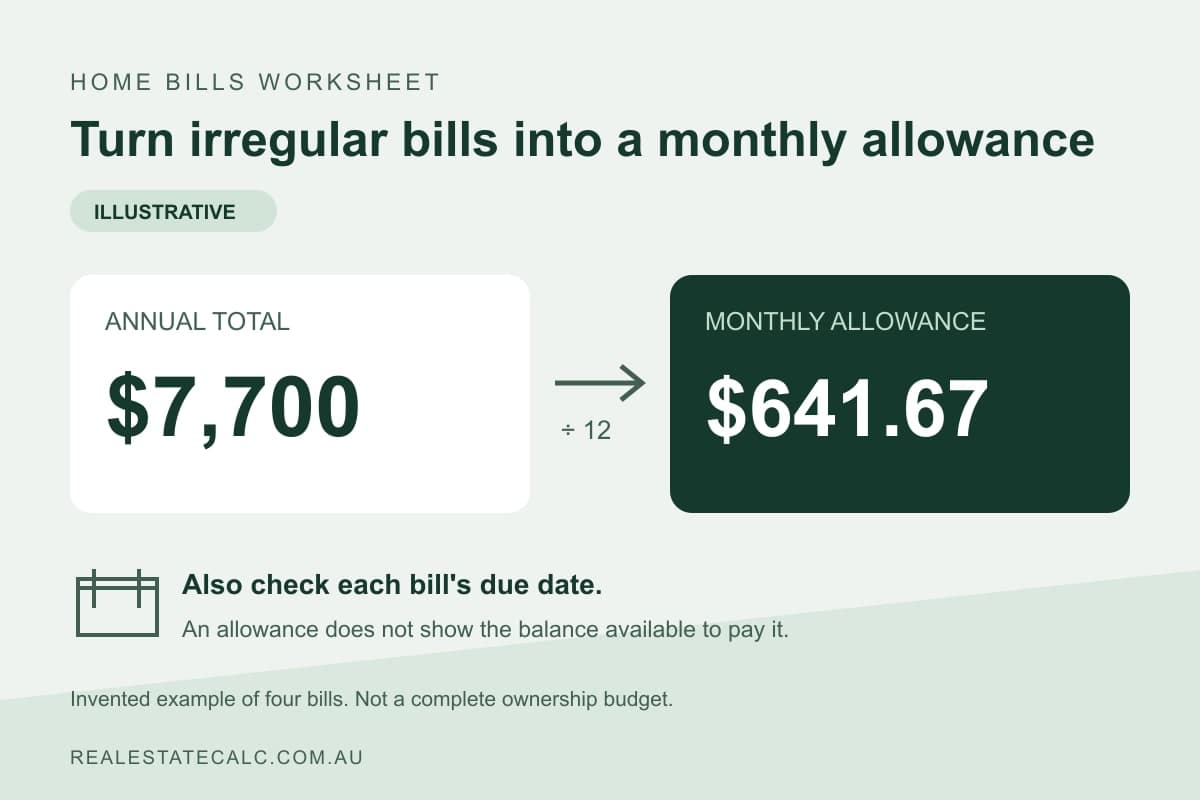
| Total for these four items | $7,700 | $641.67 |
The total monthly allowance is $7,700 divided by 12, rounded to cents. Actual electricity and water usage can vary through the year, so four times the latest bill may be a poor estimate. Review the full billing history and current prices when available.
This is not a complete ownership budget. Depending on the property, other rows could include strata contributions, maintenance, contents insurance and other charges. Check inclusions before adding them: the same building insurance cost should not appear both inside a strata allowance and again as a separate identical charge.
Keep frequency conversions consistent
A fortnight is two weeks. A month is not four weeks. For a simple annualised budget using 52 weeks and 26 fortnights:
- Weekly amount to monthly average: multiply by 52, then divide by 12.
- Fortnightly amount to monthly average: multiply by 26, then divide by 12.
- Quarterly amount to monthly average: divide by three.
- Annual amount to monthly average: divide by 12.
For example, $100 a week is $5,200 over 52 weeks, or approximately $433.33 a month. Multiplying by four would give $400 and understate that annualised allowance by $400 over 12 months.
These conversions are averages. Use the actual calendar for payment planning because the number of paydays before a particular bill can differ from an annual average.
Check the first due date separately
Suppose the example $2,300 insurance bill is due after four remaining monthly transfers. The household has already reserved $900 for it.
Amount still needed = $2,300 minus $900 = $1,400.
Transfer per remaining month = $1,400 divided by four = $350.
Starting with the steady $191.67 monthly allowance would add only $766.68 over four transfers. With the $900 already reserved, the household would have $1,666.68, leaving $633.32 unfunded. Rounding accounts for the cents.
This example assumes no interest, fees, withdrawals or changes to the bill. If the due date arrives before the next payday, dividing by future paydays does not solve the immediate shortfall. Recheck the timing and contact the provider about the actual payment options; the worksheet does not establish a right to instalments.
Do not count the reserve twice
When money moves from an everyday account into a bills account, it has been allocated, not spent on the provider's bill yet. In a consolidated household worksheet, count the bill as the expense once. Record the transfer as movement between accounts.
For a separate spending-account view, the transfer can reduce the cash available for other spending. Label that view clearly so it is not later added to the provider payment as a second expense.
Money already assigned to these bills is also different from an emergency buffer. The mortgage buffer worksheet helps separate money reserved for known commitments from cash available for other interruptions.
Refresh amounts when evidence changes
Record the amount, frequency, next due date and source beside each row. Replace an old insurance estimate with a renewal notice and revisit utility assumptions when prices or usage change.
If the future amount is unknown, label any increase as an assumption. The Inflation Calculator can model a chosen constant rate, but the August CPI update shows why an aggregate price change is not a forecast for a particular bill.
Buyers should keep these recurring costs separate from the deposit and acquisition costs in the Property Purchase Cost Calculator. A budget subtotal does not determine borrowing capacity or lender approval.
Sources and limitations
ASIC Moneysmart: How to do a budget, checked 4 October 2026, supports recording expenses and timing. All example prices and calculations are original illustrations. No provider prices, legal payment obligations, tax deductions or recommended reserve amounts are supplied.
General information and illustrative estimates only, not financial, legal, tax or credit advice, a bill quote, insurance recommendation or lending assessment. Confirm charges, inclusions and due dates with the relevant provider or authority.
Last updated: 4 October 2026.
Frequently asked questions
How do I convert a quarterly bill to a monthly allowance?
Divide the expected quarterly amount by three. For bills that vary by season or usage, use a reviewed annual estimate divided by 12 instead of assuming the latest quarter will repeat.
Is a monthly allowance enough if an annual bill is due soon?
Not necessarily. Subtract money already reserved from the expected bill, then divide the remainder by the actual number of transfers available before the due date.
RealEstateCalc Editorial
Property & Finance ResearchThe RealEstateCalc editorial team researches and writes about Australian property, finance, and tax topics. All content is fact-checked against official sources including the ATO, state revenue offices, ASIC Moneysmart, and the RBA.
Related Calculators

Mortgage Repayment Calculator
Calculate mortgage payments, total interest, and view an amortisation schedule for your home loan.
FinanceInflation Calculator Australia
Model how a constant assumed annual inflation rate changes an amount over time. This is a scenario tool, not a historical CPI lookup.
FinanceProperty Purchase Cost Calculator
Estimate the total upfront costs of buying property in Australia, including stamp duty, government fees, legal costs, inspections, insurance, and moving expenses.
PropertyRelated Articles
How to Calculate a Mortgage Buffer in Australia
Calculate months of mortgage and essential-expense cover using accessible cash, offset savings and confirmed redraw, with a worked Australian example and practical limitations.
August Inflation Rose to 4.0%: Keep Housing Bills Separate
ABS annual CPI rose to 4.0% in August 2026, with housing up 5.7%. Read the figures and a worked budget example without treating inflation as a personal bill forecast.
How to Calculate Inflation and Purchasing Power in Australia
Use a constant-rate scenario to estimate a future equivalent cost, then learn when an ABS CPI index comparison is the better method.
Ready to try the Mortgage Repayment Calculator?
Use the calculator to model an indicative estimate from the assumptions you enter.
What moved in Australian property this week — in your inbox Sunday.
RBA decisions, clearance rates, policy shifts and the calculators that dropped. Two-minute read, no filler.
Free. No spam. Unsubscribe anytime.