Try the Loan Comparison Calculator
Run the numbers while you read and see how the concepts apply to your situation.
Short answer
A lower interest rate can be outweighed by an annual home loan package fee. For a rough one-year comparison with the same unchanged interest-bearing balance, multiply that balance by the rate difference, then subtract the extra annual fees.
Illustrative annual advantage = balance x rate difference as a decimal - extra annual fees.
This is a screening calculation, not a repayment schedule or product recommendation. For estimates that account for regular principal repayments, compare matching balances and terms in the Loan Comparison Calculator.
Start with two actual alternatives
Record the rate payable on each loan, not just a discount from one lender's advertised reference rate. A large advertised discount does not show whether the resulting rate is lower than an alternative offer.
ASIC Moneysmart's home loan guidance recommends comparing loan rates, fees and features using Key Facts Sheets. It also explains that a comparison rate combines interest and most fees. Ask which charges and features apply to the specific amount and term being considered.
A package can bundle several products. For example, Westpac describes an annual-fee package with eligible home loans and other products. That demonstrates the arrangement, not a recommendation or a statement that every package works the same way. The example below uses invented figures and no lender's quoted offer.
Worked example: a $400 annual fee and a 0.10 percentage point gap
Assume two hypothetical loans have the same $300,000 balance throughout a full year. Loan A charges 6.10% with no ongoing fee. Loan B charges 6.00% with a $400 annual fee. Assume no repayments, offset, compounding, other fees or rate changes for this simple comparison.
| Item | Loan A | Loan B |
|---|---|---|
| Illustrative annual interest | $18,300 | $18,000 |
| Annual fee | $0 | $400 |
| Combined interest and fee | $18,300 | $18,400 |
Loan B's lower rate saves $300 of interest in this scenario, but its fee is $400. Its combined annual amount is therefore $100 higher.
The rate gap is 0.10 percentage points, which is 0.001 as a decimal. Using 0.10 in the multiplication would overstate the benefit by a factor of 100.
Calculate the illustrative break-even balance
With only the rate and fee difference changing:
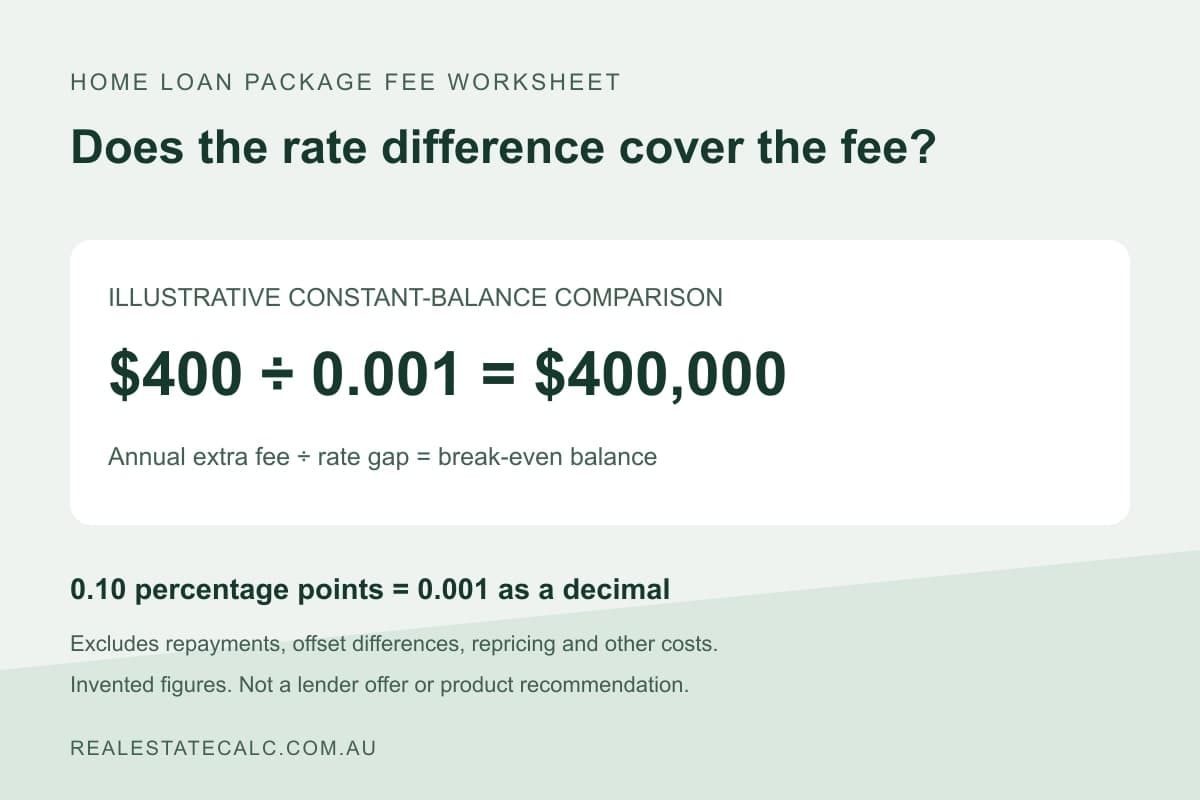
Break-even balance = extra annual fee / rate difference as a decimal.
For the example, $400 / 0.001 = $400,000. That is the unchanged interest-bearing balance at which the model's $400 interest difference equals the extra fee.
| Assumed unchanged balance | Interest saved at a 0.10 percentage point lower rate | Less $400 extra fee |
|---|---|---|
| $150,000 | $150 | -$250 |
| $300,000 | $300 | -$100 |
| $400,000 | $400 | $0 |
| $600,000 | $600 | $200 |
A positive final column means a lower combined amount for Loan B under these assumptions. It does not mean the package is suitable or that a lender will offer it.
If the rate gap is zero, dividing by zero has no meaning: there is no interest-rate saving to offset a positive fee. If the packaged rate is higher, this particular rate-discount calculation does not produce a useful positive break-even balance.
A worksheet for the details that change the answer
| Record | Why it matters |
|---|---|
| Actual rate on each alternative | A quoted discount alone is insufficient |
| Extra annual fees relative to the alternative | Compare the difference, not one fee in isolation |
| Current balance and expected repayments | A declining balance changes interest over the year |
| Offset arrangements and likely balances | Different offset access makes the simple equal-balance assumption unreliable |
| Rate-expiry and fee dates | A temporary discount and annual fee may cover different periods |
| Costs to change or leave a loan | Switching costs are outside the recurring annual comparison |
Where one package covers several loan splits, check how often the fee is charged. Do not automatically apply one whole package fee to every split, or assume all splits receive the same rate discount.
Give an unused bundled benefit a value of zero in this worksheet. An advertised fee waiver is not a saving against the alternative unless that alternative would actually incur the charge.
Take the comparison further
Use the Loan Comparison Calculator for a fuller loan scenario, checking how it handles fees and the selected term. The guide to comparison rates explains the wider cost measure. If changing lenders, also read the refinancing checklist before treating a recurring annual difference as a switching benefit.
A lower monthly repayment is not the same as a lower total cost when the remaining terms differ. Keep the term consistent, or explicitly show that it changed. The remaining loan term guide explains that input.
Sources and limitations
- ASIC Moneysmart: Choosing a home loan, checked 7 October 2026, supports comparing rates, fees and loan features.
- Westpac: Home loan package, checked 7 October 2026, provides a primary-source example of a package arrangement, not the figures in this worksheet.
- All worksheet figures are original hypothetical arithmetic. The constant-balance simplification excludes principal repayments, daily timing, tax, offset differences and future repricing.
General information and indicative calculations only, not financial, credit, legal or tax advice, a quote, loan approval or product recommendation. Confirm fees, rates and package conditions with the lender and speak with a licensed professional where appropriate.
Last updated: 7 October 2026.
Frequently asked questions
What balance covers a $400 annual fee with a 0.10 percentage point lower rate?
The simple unchanged-balance calculation gives $400,000: divide $400 by 0.001. Repayments, offset differences, other costs and rate changes can change the actual result.
Does a bigger advertised discount mean a cheaper loan?
No. Compare the resulting rate with the rate actually available on the alternative, then include fees and relevant features. Discounts from different reference rates are not directly comparable.
RealEstateCalc Editorial
Property & Finance ResearchThe RealEstateCalc editorial team researches and writes about Australian property, finance, and tax topics. All content is fact-checked against official sources including the ATO, state revenue offices, ASIC Moneysmart, and the RBA.
Related Calculators

Loan Comparison Calculator
Estimate two home loans using monthly repayments, interest and entered fees. Compare equal amounts and terms, or see the cost of changing a scenario.
FinanceMortgage Repayment Calculator
Calculate mortgage payments, total interest, and view an amortisation schedule for your home loan.
FinanceRelated Articles
Understanding Comparison Rates: Why the Advertised Rate Isn't the Full Story
What an Australian comparison rate is, how it is calculated, why it matters when comparing home loans, and its limitations. Use our Loan Comparison Calculator to compare the true cost of loans.
Home Loan Refinancing Checklist Australia: Costs, Documents and Steps
A practical Australian refinancing checklist covering switching costs, loan terms, lender documents, settlement and break-even testing.
Remaining Loan Term: The Mortgage Calculator Input That Changes the Answer
Use the remaining loan term when estimating an existing mortgage. Compare 20, 25 and 30 years and see how a lower monthly payment can hide a longer debt.
Ready to try the Loan Comparison Calculator?
Use the calculator to model an indicative estimate from the assumptions you enter.
What moved in Australian property this week — in your inbox Sunday.
RBA decisions, clearance rates, policy shifts and the calculators that dropped. Two-minute read, no filler.
Free. No spam. Unsubscribe anytime.