Victoria Steps Up Property Trust Account Audit Enforcement
Consumer Affairs Victoria announced stronger trust account audit enforcement on 15 October 2026. What buyers can check, and why a calculator cannot verify client money.
Try the Property Purchase Cost Calculator
Run the numbers while you read and see how the concepts apply to your situation.
What changed
On 15 October 2026, Consumer Affairs Victoria (CAV) announced increased enforcement against estate agents and conveyancers who fail to meet trust account obligations. Its official news alert reports more than $400,000 in fines since 2021 arising from trust account audit investigations.
This is an enforcement update. It does not change the purchase price, transfer duty or mortgage repayment calculation for a property.
Why the announcement matters to property customers
CAV explains that trust accounts hold client money, including sale deposits, rent and maintenance fees. Those funds belong to consumers rather than the business holding them. The alert says recent law changes allow the Business Licensing Authority to suspend an estate agent's or conveyancer's licence for failing to complete trust account audits.
The announcement concerns the handling of client money. It is separate from whether a provider's professional fee fits a household budget. A low fee and a plausible payment request do not, by themselves, answer questions about the recipient or the purpose of a transfer.
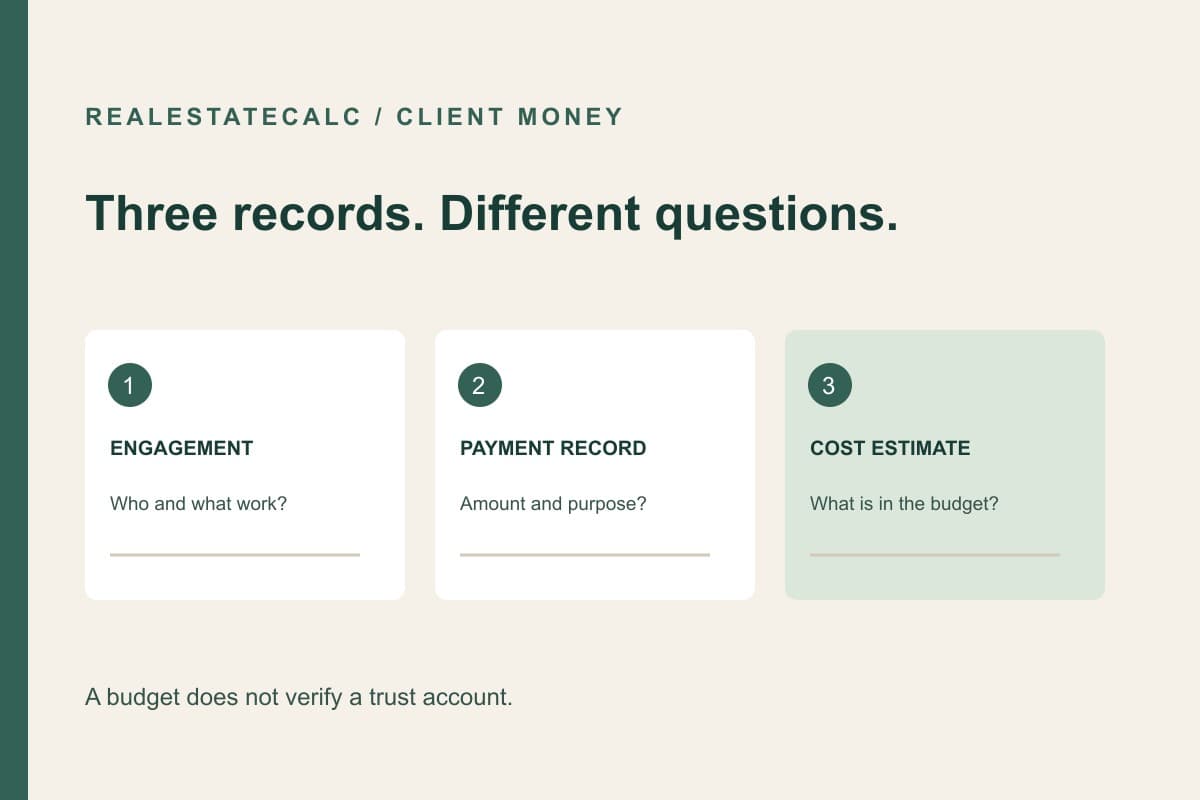
Three records to keep separate
The following is a practical record-keeping framework, not a legal checklist or confirmation that a payment is safe.
| Record | What it helps you identify | What it does not establish |
|---|---|---|
| Written engagement and fee quote | Who is doing the work and the quoted scope | Whether a later transfer request is genuine |
| Payment instruction and receipt | The amount, purpose, recipient and recorded payment | Whether every trust account obligation has been met |
| Purchase-cost estimate | The amounts included in your budget | Who is entitled to receive funds or when they must be released |
Keep a dated copy of each. If names, amounts or instructions conflict, ask your own conveyancer or solicitor to explain the difference before relying on the records.
For transfer preparation, use the settlement funds transfer checklist. For comparing professional charges, use the separate conveyancing quote worksheet.
Checks available through official guidance
CAV's property expert guidance links to the Victorian registers for conveyancers and legal practitioners. Use the appropriate register for the provider's role, and ask the provider to clarify any mismatch between the business you engaged and the details supplied to you.
A register check is one piece of information. This article does not certify an individual business, inspect a trust account or guarantee that money can be recovered if something goes wrong. Contact CAV or a qualified legal practitioner about a specific concern.
What changes in calculators?
No rates, thresholds or formulas were changed because of this alert. The Property Purchase Cost Calculator remains an indicative budget tool. It does not validate bank details, check a professional's licence or confirm a trust account balance.
For example, marking a $2,000 quoted fee as paid in a personal worksheet changes the remaining cash budget. It does not prove that a separate $50,000 deposit reached the intended account. These are hypothetical amounts used to distinguish bookkeeping from payment verification, not typical fees or a recommended deposit.
What remains uncertain
The CAV alert describes current enforcement action, including disciplinary proceedings. An allegation is not a final finding. This article does not repeat individual case allegations or infer that a named firm's clients have lost money.
No new universal consumer payment deadline or compensation entitlement is established here. Audit requirements, disciplinary status and any legal remedy need to be checked against the relevant current official information and individual circumstances.
Sources and limits
The CAV news alert dated 15 October 2026 and CAV's property expert guidance were checked on 16 October 2026. The practical record table and hypothetical example are original explanations, not requirements issued by the regulator.
General information only, not financial, legal, tax, credit or investment advice. This is not a provider endorsement, payment guarantee, legal ruling or assessment of a compensation claim. Seek qualified assistance for a particular transaction or concern.
Last updated: 16 October 2026.
RealEstateCalc Editorial
Property & Finance ResearchThe RealEstateCalc editorial team researches and writes about Australian property, finance, and tax topics. All content is fact-checked against official sources including the ATO, state revenue offices, ASIC Moneysmart, and the RBA.
Related Calculators

Related Articles
Settlement Funds Transfer Checklist for Australian Buyers
Reconcile your remaining cash contribution, check payment instructions and record receipt. A practical worksheet to discuss with your bank and conveyancer.
Conveyancing Quote Comparison: Put Fees on the Same Basis
Compare conveyancing quotes by separating professional fees, quoted tax, disbursements and exclusions. Includes an original worked example and buying-budget checklist.
Ready to try the Property Purchase Cost Calculator?
Use the calculator to model an indicative estimate from the assumptions you enter.
What moved in Australian property this week — in your inbox Sunday.
RBA decisions, clearance rates, policy shifts and the calculators that dropped. Two-minute read, no filler.
Free. No spam. Unsubscribe anytime.