Apartment Price per Square Metre: Internal Area vs Total Area
Compare apartment prices using a consistent area definition. A worked example separates internal space, balcony, parking and storage without pretending to value a property.
Try the Property Purchase Cost Calculator
Run the numbers while you read and see how the concepts apply to your situation.
Short answer
Divide the property price by a clearly identified area, then compare it only with figures calculated on the same area basis. An internal-area ratio and a ratio that includes balcony, parking and storage answer different questions. Neither is a valuation.
Use the Property Purchase Cost Calculator separately for the cash costs of buying. This guide compares a stated price with a stated area; it does not calculate duty, finance or the amount a lender might accept as security.
Record the components before dividing
For each apartment, keep the source document and its date alongside the numbers. Do not assume that every listing uses “total”, “living” or “internal” in the same way.
| Worksheet field | What to establish |
|---|---|
| Price | Asking price, price guide, agreed price or settled sale price? |
| Internal area | What spaces and measurement boundaries are included? |
| Balcony or courtyard | Separately measured, or already within another quoted figure? |
| Parking | Area shown separately, and what rights attach to it? |
| Storage | Included inside the apartment, separate, or already counted elsewhere? |
| Total | Which components were added, and are any overlapping? |
Ask the agent to clarify the figures in writing. If the source does not separate the areas, record the gap instead of estimating it from a photograph. A floor plan drawn for marketing and a title document serve different purposes.
For NSW properties, NSW Fair Trading's strata buying guidance directs buyers to check the strata plan and by-laws to understand their lot and common property, and to have their solicitor or conveyancer explain the contract's title information. A numerical area comparison does not resolve ownership boundaries or exclusive-use rights. Check the appropriate documents and professional advice in the property's jurisdiction.
Worked example: the denominator changes the apparent comparison
These are invented properties and prices, not market observations. Assume the areas are verified, use the same measurement method and do not overlap. The total price includes all listed components; no separate value has been assigned to parking, storage or outdoor space.
| Item | Apartment A | Apartment B |
|---|---|---|
| Assumed price | $900,000 | $900,000 |
| Internal area | 75 m² | 80 m² |
| Balcony | 15 m² | 8 m² |
| Parking | 14 m² | 14 m² |
| Separate storage | 6 m² | 3 m² |
| Sum of listed areas | 110 m² | 105 m² |
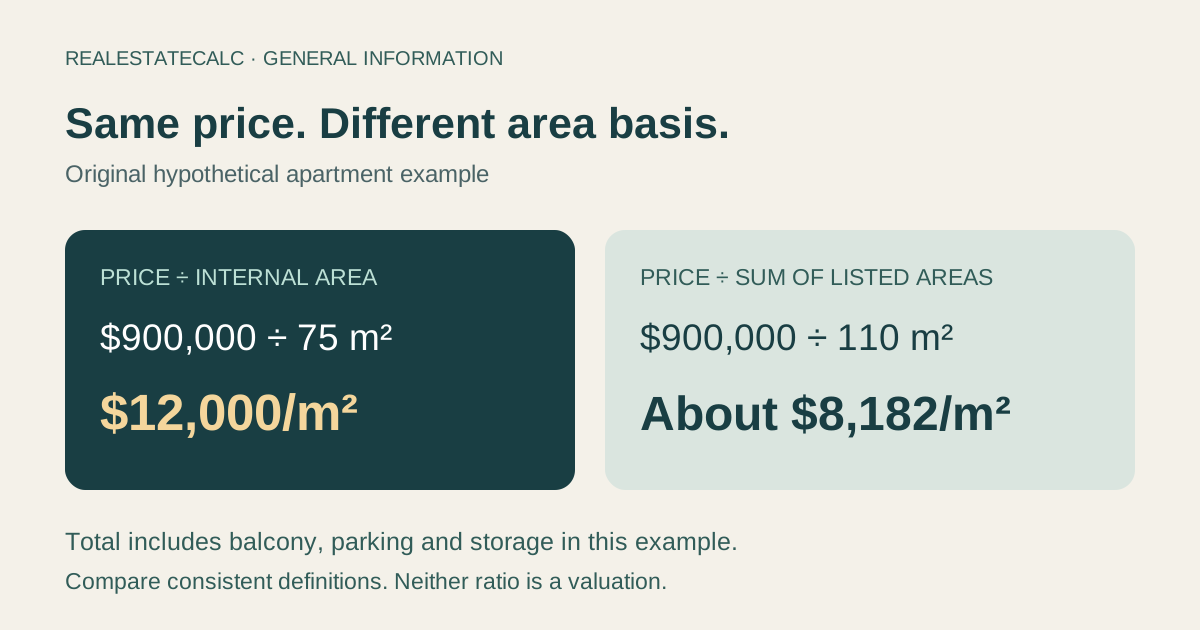
| Price ÷ internal area | $12,000/m² | $11,250/m² |
| Price ÷ sum of listed areas | About $8,182/m² | About $8,571/m² |
Apartment A has the lower ratio using the sum of all listed areas. Apartment B has the lower ratio using internal area. Nothing about either price has changed; the denominator has changed.
For A, the two calculations are $900,000 ÷ 75 and $900,000 ÷ 110. For B, they are $900,000 ÷ 80 and $900,000 ÷ 105. Round only the displayed result, and keep the original areas in the worksheet.
The internal-area ratio still allocates the whole purchase price to internal square metres for comparison. It does not mean that the balcony or car space is worth zero. Equally, the total-area ratio does not mean that a square metre of parking has the same market value as a square metre of living space.
When the calculation should stop
Do not divide by zero or enter a missing area as zero. If only a combined figure is available, an internal-area ratio cannot be calculated from that figure alone. If the areas come from different measurement methods, mark the comparison as unresolved until they can be reconciled.
Keep asking prices separate from settled sale prices. If one property's price is a range, calculate a range using the same area; do not quietly choose its lower end while using a firm sale price for another property.
For example, a hypothetical $880,000 to $920,000 asking range and 80 m² internal area produces $11,000 to $11,500/m². It does not reveal the eventual transaction price.
What the ratio leaves out
A small ratio is not evidence that an apartment is good value. Building condition, layout, noise, light, access, location and ongoing costs remain outside the calculation. The same area can be arranged very differently: a long corridor and a useful living room both occupy space.
Strata contributions also require their own records. Do not use an apartment's percentage of total floor area as a substitute for its levy share. The NSW unit entitlement worked example explains that separate input, and the special levy cash-flow worksheet puts a known levy into a payment schedule.
Common questions
Should I give balconies half the weight of internal space? This guide supplies no market weighting. A chosen weighting is an assumption, not a verified valuation rule. Keep the components visible rather than presenting an invented adjustment as a market fact.
Can I multiply the ratio by a different apartment's area to value it? The multiplication is possible, but this worksheet does not establish comparable market value. It does not control for the differences between the properties.
Does a precinct announcement provide an apartment price benchmark? No. The Bays West design shortlist update, for example, concerns a design milestone rather than individual apartment prices or floor areas.
Sources and limitations
NSW Fair Trading's guidance linked above checked 21 October 2026. It supports the document checks, not a national area-measurement standard or a pricing formula. The worksheet and numbers are original hypothetical examples. No construction standard, minimum apartment size or entitlement rule is asserted here.
General information only, not financial, legal, tax, credit or investment advice, a valuation or a recommendation to buy. Verify measurements and property documents with appropriately qualified professionals before relying on them.
Last updated: 21 October 2026.
RealEstateCalc Editorial
Property & Finance ResearchThe RealEstateCalc editorial team researches and writes about Australian property, finance, and tax topics. All content is fact-checked against official sources including the ATO, state revenue offices, ASIC Moneysmart, and the RBA.
Related Calculators

Related Articles
NSW Strata Unit Entitlements: A Worked Levy-Share Example
Translate an assumed NSW strata levy total into a lot share, with separate administrative and capital works amounts, quarterly examples and checks against the actual notice.
Strata Special Levy Budget: Check the Due Dates, Not Just the Total
Build a cash-flow worksheet for a known strata special levy. Separate regular levies, one-off instalments and available savings, with a worked example of a timing shortfall.
Ready to try the Property Purchase Cost Calculator?
Use the calculator to model an indicative estimate from the assumptions you enter.
What moved in Australian property this week — in your inbox Sunday.
RBA decisions, clearance rates, policy shifts and the calculators that dropped. Two-minute read, no filler.
Free. No spam. Unsubscribe anytime.