Try the Property Purchase Cost Calculator
Run the numbers while you read and see how the concepts apply to your situation.
Short answer
Simple payback in years = upfront cost ÷ annual cash saving. It estimates how long constant savings would take to recover an initial outlay. It does not establish whether an upgrade is suitable, how long it will last or what your home will be worth.
For an insulation or appliance quote, start with the amount you would actually pay, including necessary extras. Then separate a measured or modelled energy saving from an advertised bill-saving claim. The Australian Government's Your Home affordability guide explains the basic payback method and why a fuller lifecycle comparison can be useful.
If the upgrade accompanies a purchase, calculate acquisition costs with the Property Purchase Cost Calculator first. Keep the works budget separate so the same cash is not allocated twice.
Step 1: establish the upfront cost once
Use the same scope and GST basis for each quote. A government incentive may already be included in the amount labelled payable.
| Quote check | What belongs in the worksheet |
|---|---|
| Before or after discount? | Use the amount payable after a confirmed discount, once |
| Assessment costs | Add only if required and outside the installation quote |
| Other necessary work | Use separately confirmed costs, without duplicating inclusions |
| Uncertain work | Show a separate scenario or reserve until the scope is known |
| Payment timing | Record the deposit and later payments as parts of the total |
For example, $3,200 of quoted work less a confirmed $1,200 discount gives $2,000 payable. A separate $250 assessment brings the modelled cost to $2,250. Subtracting $1,200 again from the net quote would be a double count. A deposit included in the $2,000 is also not an extra project cost.
These are invented numbers, not typical prices. The Victorian insulation discount update shows why the actual provider quote matters. Other programs have different rules; do not transfer one state's discount to another.
Step 2: estimate the annual cash saving
The relevant amount is the reduction in cash costs for the same comparison period, less any additional ongoing costs caused by the upgrade. Keep the units beside the estimate.
A simplified invented electricity-only example assumes 1,000 fewer kilowatt-hours bought each year at a constant $0.30 per kilowatt-hour. The estimated usage saving is $300 a year. An unchanged daily supply charge contributes $0 to the saving. If additional maintenance is estimated at $40 a year, the net annual saving becomes $260.
This assumes one import tariff and unchanged supply arrangements. It is not a model for solar exports, time-of-use pricing, gas replacement or demand tariffs. Those need a bill comparison that accounts for the relevant rates and charges. Do not multiply an entire bill by an efficiency percentage when some charges would remain unchanged.
Ask whoever prepared the saving estimate to identify the baseline, weather assumptions, occupancy, equipment use and tariffs. A smaller bill after installation does not by itself prove the whole difference came from the upgrade: prices, weather and household use may also have changed.
Step 3: test more than one saving
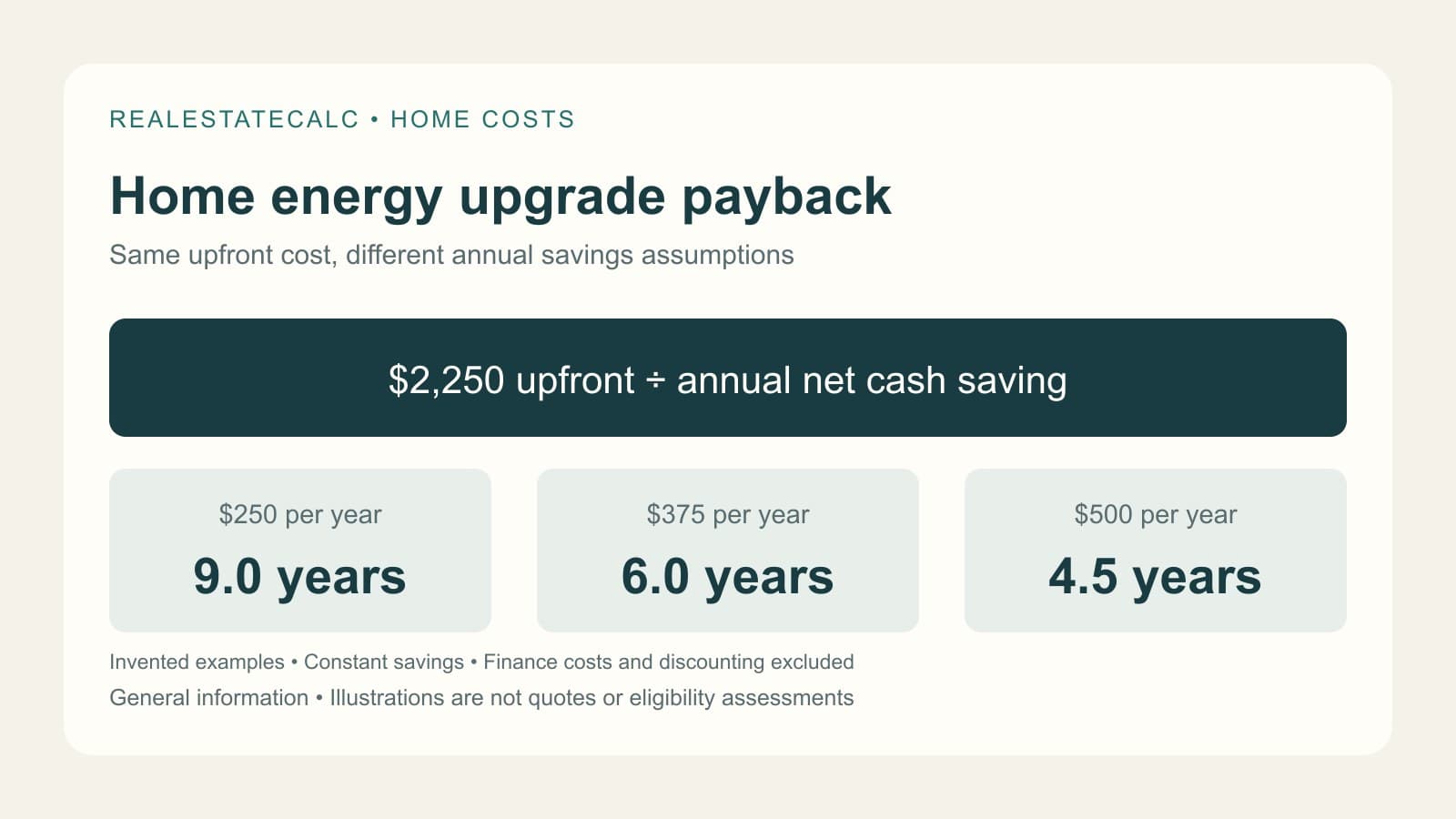
Using the $2,250 upfront cost above, the following scenarios assume constant annual net savings and exclude finance costs:
| Assumed net annual cash saving | Simple payback |
|---|---|
| $250 | 9.0 years |
| $375 | 6.0 years |
| $500 | 4.5 years |
These are sensitivity scenarios, not a forecast or promised range. For the separate $260 example, $2,250 ÷ $260 is approximately 8.7 years. If the net annual saving is zero or negative, this calculation gives no positive finite payback. Zero annual savings do not recover the outlay; negative savings increase annual costs.
The annual saving is also not cash available on installation day. At a hypothetical $375 annual saving, a monthly budgeting average is $31.25, but actual savings may be concentrated in heating or cooling seasons. The annual bills budget guide explains the difference between an average allowance and bill timing.
What simple payback leaves out
Simple payback does not discount future savings, model future energy prices, include benefits after the payback date or establish equipment life. The Australian Government's energy savings measurement guide identifies these limits. A short payback estimate alone is not a complete assessment of value.
Also keep comfort and safety benefits visible without inventing a dollar value for them. An upgrade can have a purpose beyond bill savings. Conversely, if the equipment needs replacement before the estimated payback date, dividing once by annual savings hides that later expense.
If borrowing is proposed, record interest, fees and the repayment schedule separately. The Mortgage Repayment Calculator can illustrate a loan scenario. It does not approve finance, model the upgrade's performance or turn this simple worksheet into a discounted cash-flow analysis. A funding decision needs more than a payback number.
Common questions
Whose savings belong in the calculation for a rental property?
Keep the payer and beneficiary consistent. If the owner pays for works but the tenant pays the energy bill, the tenant's estimated bill saving is not automatically cash received by the owner. Do not assume higher rent, a tax deduction or a sale-price uplift to fill the gap.
Can a larger rebate make a quote cheaper overall?
Only comparing the final like-for-like cost answers that. A $4,000 quote with a $1,500 discount costs $2,500; a $3,200 quote with a $1,000 discount costs $2,200 before any extras. The larger discount does not necessarily mean the smaller outlay.
Sources and limitations
Sources checked 11 October 2026: Your Home's affordability guidance for the formula; the Australian Government energy savings measurement guide for method limitations; and the linked Energy Victoria update for the current program context. All worksheet figures are original hypothetical arithmetic. This is a worked example, not an energy audit, rebate calculator or product ranking.
General information only, not financial, credit, legal, tax or investment advice, a quote or a recommendation to buy or borrow. Confirm costs, eligibility, technical suitability and safety with the relevant authority and qualified professionals.
Last updated: 11 October 2026.
Frequently asked questions
How is simple payback calculated for a home energy upgrade?
Divide the upfront cost actually payable by a positive annual net cash saving. This simplified method assumes constant savings and excludes financing and the time value of money.
Do unchanged electricity supply charges count towards energy savings?
No. A charge that stays the same contributes nothing to the saving. Compare the actual bill components and any additional ongoing costs.
RealEstateCalc Editorial
Property & Finance ResearchThe RealEstateCalc editorial team researches and writes about Australian property, finance, and tax topics. All content is fact-checked against official sources including the ATO, state revenue offices, ASIC Moneysmart, and the RBA.
Related Calculators

Property Purchase Cost Calculator
Estimate the total upfront costs of buying property in Australia, including stamp duty, government fees, legal costs, inspections, insurance, and moving expenses.
PropertyMortgage Repayment Calculator
Calculate mortgage payments, total interest, and view an amortisation schedule for your home loan.
FinanceRelated Articles
Victoria Expands Ceiling Insulation Discounts from 1 October
Victoria has expanded access to ceiling insulation discounts. Check the net quote, assessments and property-specific savings before setting an upgrade budget.
Renovation Contingency Budget: Keep the Reserve Separate
Build a renovation budget that separates quoted work, known extras and an unspent contingency reserve. Follow a transparent Australian dollar worked example.
Annual and Quarterly Home Bills: Build a Monthly Allowance
Convert annual and quarterly home bills into a monthly allowance, then check cash available before each due date. Includes an Australian dollar worked worksheet.
Ready to try the Property Purchase Cost Calculator?
Use the calculator to model an indicative estimate from the assumptions you enter.
What moved in Australian property this week — in your inbox Sunday.
RBA decisions, clearance rates, policy shifts and the calculators that dropped. Two-minute read, no filler.
Free. No spam. Unsubscribe anytime.