How Long Does It Take to Build a House in Australia?
A practical Australian house-build timeline from preconstruction to handover, with common delay causes and a worked example of rent and build-stage interest costs.
Try the Property Purchase Cost Calculator
Run the numbers while you read and see how the concepts apply to your situation.
Short answer
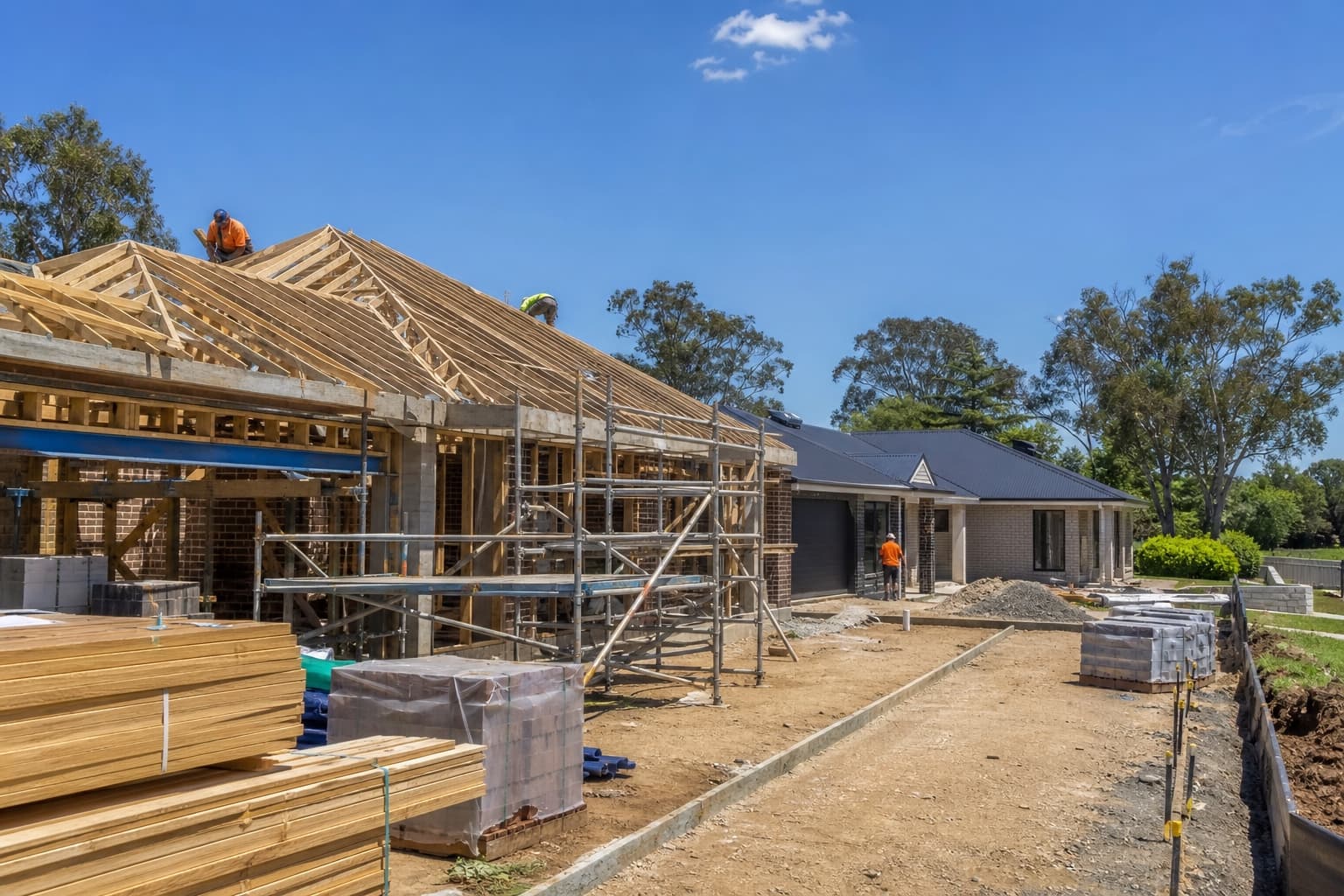
Australian Government YourHome guidance says a brick single-storey house can take around five or six months to construct, but often takes much longer. That is construction time, not the whole journey from choosing land and a design to moving in.
Site conditions, approvals, contract documentation, builder capacity, trade and material availability, weather, variations, inspections and finance can all extend the timeline. A builder's written program and contract matter more for a specific project than a national average.
Use this guide to build a timing budget, not to predict a completion date.
The timeline starts before construction
A useful plan separates preconstruction from physical building work.
Preconstruction
This can include:
- checking the site, title, services and planning controls;
- selecting or designing the house;
- soil, survey, engineering and energy work;
- obtaining comparable builder quotes;
- reviewing the plans, specifications, allowances and contract;
- obtaining planning, building and other required approvals; and
- arranging finance, insurance and authority to commence.
Construction should not be assumed to start when a preliminary quote is accepted. YourHome says construction can begin once the contract and necessary approvals and permits are in place.
The Property Purchase Cost Calculator can estimate land-purchase costs, but it does not estimate design, approval or construction costs.
Common construction stages
Stage names and payment schedules vary by contract and jurisdiction. A practical sequence is:
| Stage | Typical work | Timing risk to watch |
|---|---|---|
| Site preparation and footings | Demolition or clearing, retaining, levels, drainage, termite protection and concrete | Unexpected ground conditions, weather and service locations |
| Frame or building shell | Frame, masonry, roof, cladding, membranes, insulation and rough-in services | Trade sequencing and material lead times |
| Lock-up | External doors and windows make the structure secure and weather-resistant | Window, door and cladding supply |
| Fit-out | Cabinets, benchtops, tiling, electrical, plumbing and internal finishes | Selections, substitutions, rework and multiple trades |
| Practical completion | Painting, installations, testing, inspection, defects and handover steps | Incomplete items, certificates and disputed defects |
The construction loan progress-payment guide explains how lender drawdowns can follow stages. A label such as lock-up does not create a universal percentage payment or prove that every item is complete.
Why a five or six-month build can take longer
Site and approval work
A sloping, reactive, constrained, bushfire-prone or poorly serviced site can require more investigation and work than a straightforward serviced lot. Approval and certification timing also varies by state, council and project.
Builder and trade availability
A signed contract does not guarantee that every trade is immediately available. The builder must coordinate trades and materials in sequence. One missed task can hold up the next stage.
Materials and selections
Long-lead windows, engineered products, appliances or finishes can affect the program. Late selections and substitutions can also create redesign, approval or price questions.
Weather
Rain, heat, wind and other site conditions can stop particular work. The effect depends on the stage and contract, not just the number of wet days.
Variations and incomplete documents
YourHome notes that many small variations can add significant cost and time. Resolve the design, specifications and allowances before signing where possible, and record any agreed variation and its timing effect in writing.
Read the provisional sums guide for the difference between a contract allowance and a fixed final cost.
Inspections, certificates and defects
Required inspections can identify work that must be corrected before it is covered or the next stage proceeds. Practical completion is also not necessarily the same as final completion after a defects period.
A delay can create several costs at once
Do not budget only for a higher builder invoice. A delay can extend:
- rent or temporary accommodation;
- construction-loan interest;
- storage;
- insurance and site costs;
- council rates and utilities;
- quote or rate-lock validity periods; and
- time away from work for inspections or decisions.
Contract terms determine whether any cost can be claimed from another party. This guide does not interpret delay, extension-of-time or liquidated-damages clauses.
Worked example: 12-week delay
Assume a household pays $650 a week in rent while building. A 12-week delay adds:
$650 x 12 = $7,800
Assume the construction loan has an average drawn balance of $350,000 during the same period and a 6.50% annual rate. A simplified interest-only estimate is:
$350,000 x 6.50% x 12 / 52 = $5,250
Combined rent and simplified interest are:
$7,800 + $5,250 = $13,050
This is an illustration, not a lender quote or claim under a building contract. Actual loan interest is commonly calculated daily, the drawn balance changes after progress payments, the rate can change, and other delay costs are excluded.
The Mortgage Repayment Calculator models a completed loan with one balance. It does not model staged construction drawdowns. Use written lender figures for the build period.
Build a timeline buffer from documents
Before signing, collect:
| Document or answer | What to check |
|---|---|
| Builder program | Proposed start, stages, dependencies and practical completion |
| Building contract | Time calculation, extensions, variations, notices, completion and dispute process |
| Plans and specifications | Whether products, finishes and performance requirements are complete |
| Prime cost and provisional sum schedule | Which amounts remain allowances |
| Approval list | Which permits and certificates are outstanding and who obtains them |
| Construction loan schedule | Drawdown stages, contribution order, inspection evidence and loan time limit |
| Temporary housing plan | Rent end date, flexibility, storage and overlap buffer |
| Insurance confirmation | Cover before, during and after construction |
Ask the builder and lender what happens if completion moves beyond the stated loan or accommodation period. Keep the answer in writing.
What national data can and cannot tell you
The August 2026 National Housing Supply and Affordability Council report says average approval-to-completion time for new houses was 10% faster in 2024-25 than in 2023-24. It also says no newer construction-time data had been released since its March report.
That measure is useful market context but it is not a current duration for every 2026 build. It begins at building approval, includes completed projects and averages different sites, designs and jurisdictions.
The August Housing Accord update reports the national pipeline without turning it into a promise for an individual project.
Common mistakes
- Treating five or six months as a guaranteed whole-project duration.
- Starting the clock at quote acceptance rather than the contract and approval milestone.
- Assuming progress-payment stages have the same value in every contract.
- Budgeting rent but not construction-loan interest during a delay.
- Spending the contingency on upgrades before site risks are resolved.
- Agreeing to variations without recording cost and time effects.
- Treating practical completion as proof that every defect is fixed.
- Using a national average instead of the builder's written program and contract.
Sources
- Australian Government YourHome: Building a house, including the construction stages, timing range and delay causes. Updated in 2026 and checked 24 August 2026.
- NSW Planning Portal: Build phase guidance, used as a state example for build stages, inspections and progress processes. Checked 24 August 2026.
- National Housing Supply and Affordability Council: Quarterly Report, August 2026, published 21 August 2026 and checked 24 August 2026.
General information disclaimer
This guide provides general information and simplified estimates only. It is not a builder quote, completion guarantee, contract interpretation, legal advice, credit advice, financial advice or engineering advice. Timelines, payments, costs, approvals and legal rights vary by project and jurisdiction. Check the proposed building and loan contracts with appropriately qualified professionals.
Last updated: 24 August 2026.
Frequently asked questions
How long does it take to build a house in Australia?
Australian Government YourHome guidance says a brick single-storey home can take around five or six months to construct, but often takes much longer. Design, approvals and preconstruction can add substantial time before building starts.
What are the main stages of building a house?
A common sequence is site preparation and footings, frame or shell, lock-up, fit-out and practical completion. Contracts and lender payment schedules can use different labels and values.
What costs can continue when a build is delayed?
Temporary rent, construction-loan interest, storage, insurance, rates and utilities can continue. Contract terms determine whether any amount can be recovered from another party.
Does the Mortgage Repayment Calculator model construction drawdowns?
No. It models one completed-loan balance, rate and term. Construction loans can release funds in stages, so build-period interest needs a separate lender-specific estimate.
RealEstateCalc Editorial
Property & Finance ResearchThe RealEstateCalc editorial team researches and writes about Australian property, finance, and tax topics. All content is fact-checked against official sources including the ATO, state revenue offices, ASIC Moneysmart, and the RBA.
Related Calculators

Property Purchase Cost Calculator
Estimate the total upfront costs of buying property in Australia, including stamp duty, government fees, legal costs, inspections, insurance, and moving expenses.
PropertyMortgage Repayment Calculator
Calculate mortgage payments, total interest, and view an amortisation schedule for your home loan.
FinanceLoan Comparison Calculator
Estimate two home loans using monthly repayments, interest and entered fees. Compare equal amounts and terms, or see the cost of changing a scenario.
FinanceRelated Articles
Construction Loans in Australia: Progress Payments and Drawdowns
Understand how construction loan drawdowns, progress payments and build-stage interest can work, with a practical Australian example and clear lender and contract limitations.
Provisional Sums in Building Contracts: A Cost Check Before You Sign
A provisional sum is an estimated allowance for building work that cannot be priced exactly at contract signing. Learn how to compare the variable part of Australian building quotes.
Construction Cost Index Australia: Which ABS Measure Should You Use?
A practical guide to Australian construction cost indexes, including house inputs, builder output prices and CPI new dwellings, with worked index examples and limits.
Ready to try the Property Purchase Cost Calculator?
Use the calculator to model an indicative estimate from the assumptions you enter.
What moved in Australian property this week — in your inbox Sunday.
RBA decisions, clearance rates, policy shifts and the calculators that dropped. Two-minute read, no filler.
Free. No spam. Unsubscribe anytime.