Try the Rent-to-Income Ratio Calculator Australia
Run the numbers while you read and see how the concepts apply to your situation.
Short answer
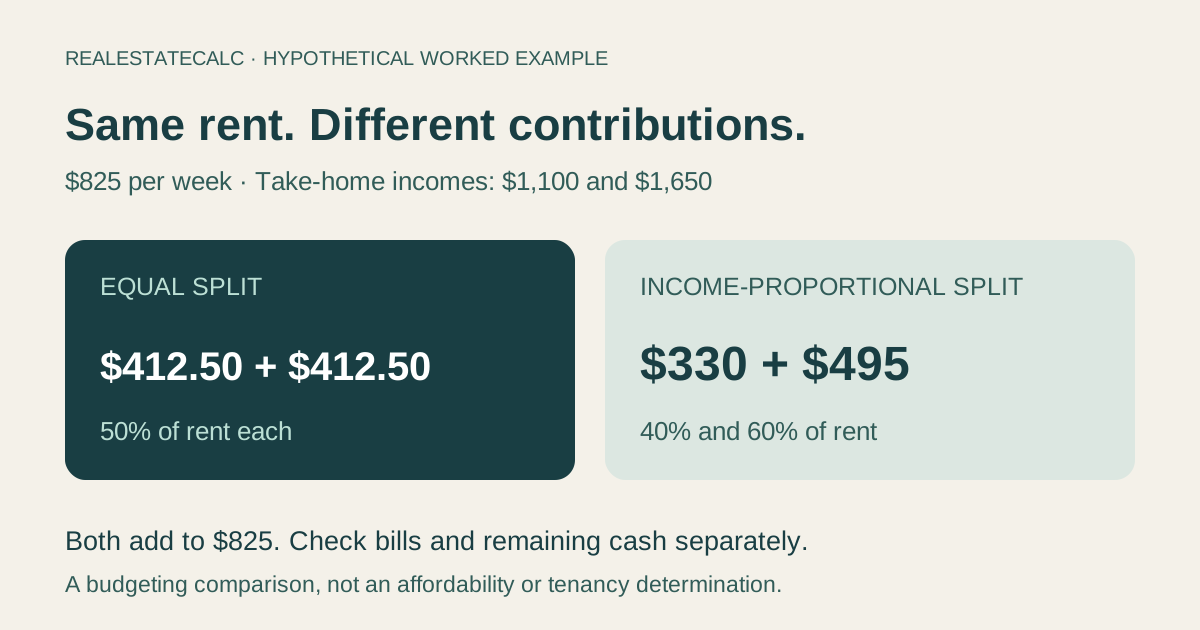
For an income-proportional split, multiply the total rent by each person's share of combined income. Use income measured on the same basis and over the same period. This calculates a possible contribution; it does not decide what is fair or change anyone's tenancy obligations.
The Rent-to-Income Ratio Calculator uses gross income before tax. It can compare one person's rent contribution with their own gross income, or whole rent with combined gross household income. Do not enter this worksheet's take-home figures into its gross-income field: the ratios use different income bases and are not directly comparable.
Choose the inputs before choosing a split
Start with the actual weekly rent and the number of people sharing it. Agree whether the comparison uses take-home income or gross income. For a separate income-and-expenses budget, ASIC Moneysmart's Simple Money Manager provides a budgeting tool in multiple languages.
This worksheet uses hypothetical weekly take-home pay, after tax and payroll deductions. The income is assumed stable. It is not a recommendation to disclose income to housemates or to adopt a particular arrangement.
| Input | Person A | Person B | Combined |
|---|---|---|---|
| Weekly take-home income | $1,100 | $1,650 | $2,750 |
| Share of combined income | 40% | 60% | 100% |
| Total weekly rent | $825 |
A's share is $1,100 ÷ $2,750 = 40%. B's share is $1,650 ÷ $2,750 = 60%. These percentages are shares of combined income, not shares of floor area or legal liability.
Compare two ways to divide the same rent
| Weekly result | Equal split: A | Equal split: B | Income split: A | Income split: B |
|---|---|---|---|---|
| Rent contribution | $412.50 | $412.50 | $330 | $495 |
| Contribution ÷ own take-home income | 37.5% | 25% | 30% | 30% |
| Income left after rent only | $687.50 | $1,237.50 | $770 | $1,155 |
Equal contributions produce different income percentages. Proportional contributions produce the same percentage of each person's income. Neither result proves that the rent is affordable. The remaining money must still cover each person's other costs.
Under both methods, the rent contributions add to $825. The combined rent-to-income ratio is also unchanged: $825 ÷ $2,750 = 30%. A household-level ratio cannot show which person has less money left after their own bills.
Add shared bills separately
A household can test different assumptions for rent and bills without treating either as an official rule. Suppose shared utilities and internet average $90 a week and, for this example only, the two people divide them equally.
Under the income-based rent split, A contributes $330 + $45 = $375 a week towards rent and these bills. B contributes $495 + $45 = $540. Their remaining weekly cash is $725 and $1,110 respectively, before groceries, transport, debt payments and other personal expenses.
Do not include an electricity bill twice if it is already included in the stated rent. Keep actual payment dates alongside averages. Our annual and quarterly bills guide explains why an average allowance does not show whether enough cash is available on a bill's due date.
Put each person's own costs back into the picture
For an illustration, assume A has $520 a week of other costs and B has $900. After the income-based rent contributions and equal shared bills, the hypothetical balances are $205 for A and $210 for B.
Those near-equal balances are a result of the invented inputs, not a goal the formula guarantees. If either person has irregular bills, unpaid leave, caring costs or repayments omitted from the worksheet, the apparent surplus will overstate money available. Moneysmart's budgeting guidance includes regular costs, debt payments and irregular expenses.
Frequency, rounding and missing data
For a planning average, divide fortnightly income by two, or multiply monthly income by 12 and divide by 52. Do not divide a monthly amount by four. For example, $4,766.67 a month is approximately $1,100 a week on that convention. An actual calendar of pay and rent dates is still needed for payment timing.
Calculate shares using unrounded incomes, then round contributions to cents. If rounding leaves a one-cent difference, record who covers that cent so the total matches the rent. Do not let a spreadsheet silently create a shortfall.
If combined income is zero, the proportional formula is undefined. If someone has no income, it allocates zero to that person, but that is only the mathematical result of the chosen method. It does not remove an obligation or make the proposed arrangement workable. Negative or unknown incomes also need clarification before applying this simple worksheet.
Common questions
What if one room is much larger? This income formula does not account for room size, parking or facilities. Record those considerations separately. There is no room premium or definition of fairness built into this example.
What if income changes? Recalculate a clearly dated scenario using the same basis for everyone. Keep the original agreement and any proposed revision separate. This guide does not determine whether or how an agreement can legally change.
Does an agreed share limit liability to the landlord? This worksheet makes no determination about liability, subletting, bond allocation or tenancy rights. Check the agreement and the relevant state or territory tenancy authority, or obtain qualified advice.
What about moving costs? Bond and one-off moving payments belong in a separate schedule. Use the rental move cash-flow worksheet rather than spreading an uncertain bond refund into weekly income.
Sources and limitations
ASIC Moneysmart sources linked above checked 22 October 2026. They support complete budgeting and clear income categories, not an official rent-splitting method. All rent, income and expense figures here are original hypothetical examples, not Australian market averages or a case study.
General information only, not financial, legal, tax, credit or investment advice, a rental affordability assessment or a recommendation for any household. No tenancy rights, benefit entitlements or housing eligibility are calculated.
Last updated: 22 October 2026.
RealEstateCalc Editorial
Property & Finance ResearchThe RealEstateCalc editorial team researches and writes about Australian property, finance, and tax topics. All content is fact-checked against official sources including the ATO, state revenue offices, ASIC Moneysmart, and the RBA.
Related Calculators

Related Articles
Rental Move Budget: Bond and Cash-Flow Worksheet
Track when a new bond, rent and moving invoices are due. An original worksheet shows why a later bond refund cannot fund an earlier payment.
Annual and Quarterly Home Bills: Build a Monthly Allowance
Convert annual and quarterly home bills into a monthly allowance, then check cash available before each due date. Includes an Australian dollar worked worksheet.
Ready to try the Rent-to-Income Ratio Calculator Australia?
Use the calculator to model an indicative estimate from the assumptions you enter.
What moved in Australian property this week — in your inbox Sunday.
RBA decisions, clearance rates, policy shifts and the calculators that dropped. Two-minute read, no filler.
Free. No spam. Unsubscribe anytime.