Investor check
Compare yield, cash flow and tax together
A yield headline is only useful after vacancy, land tax, strata and interest are included.
Short answer
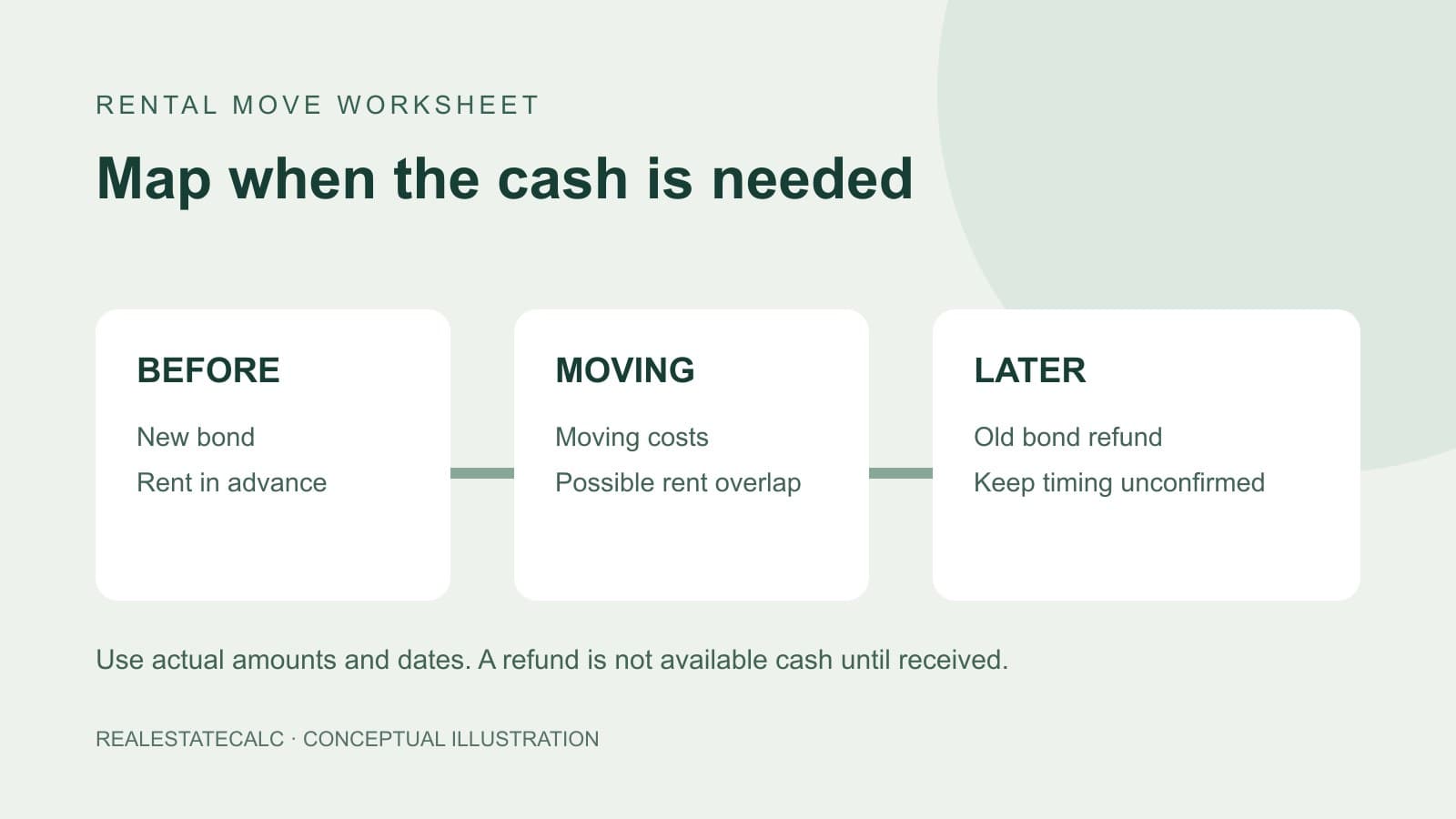
A moving budget needs payment dates as well as totals. An old bond expected back after the move cannot fund a new bond due beforehand. Keep money tied up in bonds separate from spending on removalists, overlapping rent and other invoices.
This original worksheet estimates the lowest cash balance during a move. It does not decide how much bond can legally be charged or whether a claim is valid. Use the Rent-to-Income Ratio Calculator for the separate question of ongoing rent relative to income.
Collect amounts before building the timeline
ASIC's Moneysmart rental bonds and leases guide explains that rent is only one part of moving costs and that rental rules differ by state and territory.
For each payment, record the amount, due date and source document. For an incoming amount, record whether its value and arrival date are confirmed. Do not include a disputed or unconfirmed refund as available cash.
| Item | Amount to record | Treatment in the worksheet |
|---|---|---|
| Cash allocated to the move | Money actually available after other commitments | Opening balance |
| New bond | Confirmed amount and payment date | Cash outflow, tracked separately from expenses |
| Rent paid in advance | Amount and the dates it covers | Cash outflow for that rent period |
| Old tenancy rent still payable | Amount and covered dates | Include only amounts not already counted |
| Removalist and connection invoices | Actual quotes and due dates | Moving expenses |
| Old bond repayment | Confirmed amount when known | Inflow only when received, or a clearly labelled scenario |
| Other income and living costs | Expected dates and amounts | Add if the move fund is not kept separate |
A bond repayment is a release of money previously tied up. It is not wages or a discount on removalist charges. A bond may also have deductions or be repayable to someone other than the renter, depending on its funding and the claim outcome.
Worked example: the lowest balance comes before the refund
Assume a renter has $6,000 specifically allocated to this move, with ordinary living costs funded separately. The amounts below are invented, not legal bond limits, standard rent-in-advance requirements or market quotes. No bond transfer is used.
| Day | Transaction | Cash movement | Move fund balance |
|---|---|---|---|
| Opening | Available move fund | $6,000 in | $6,000 |
| 1 | New bond | $2,600 out | $3,400 |
| 3 | New rent paid in advance for the first agreed period | $1,300 out | $2,100 |
| 5 | Remaining old-tenancy rent, not previously paid | $600 out | $1,500 |
| 7 | Removalist and connection invoices | $950 out | $550 |
| 21 | Assumed old bond repayment | $2,400 in | $2,950 |
Outflows before the assumed repayment total $5,450. The lowest modelled balance is $550, even though the ending balance is $2,950. If only the net $3,050 were set aside ($5,450 minus $2,400), the fund would be $2,400 short before the refund arrived.
The dates are hypothetical. Day 21 is not a stated refund processing time. Consumer Affairs Victoria's bond claims guidance explains the Victorian repayment and dispute process. Check the relevant authority for your state and actual claim.
Test delay and deduction separately
If the same $2,400 arrives on day 35 instead, the fund remains at $550 for longer, before any further payments. Add later rent and other obligations if they come from this fund; a delayed refund may then change the lowest balance.
If only $2,000 is repaid on day 21 in a hypothetical second scenario, the ending balance becomes $2,550. The earlier minimum remains $550 because the changed repayment happens after those outflows. This does not suggest a $400 deduction is valid or typical.
The calculation is simply: new balance = previous balance + receipts - payments. Sort entries by actual date and inspect every balance, not just the last row. A negative balance means the entered timeline has a shortfall; it is not a recommendation to borrow.
Avoid counting the same rent twice
Rent paid in advance covers a stated period. Do not enter that payment and then enter the same covered rent again as a second expense. Where two tenancies overlap, identify which dates and amounts belong to each home.
For the example, $1,300 and $600 cover different tenancy obligations. The worksheet makes no claim about notice periods, lease-break fees or the rent legally owed. Those require separate checks of the agreement and current local rules.
What if a bond can be transferred?
Some jurisdictions provide a bond-transfer process. Confirm the applicable scheme, conditions, timing, fees and any top-up before replacing a new-bond payment in the timeline. A transfer is not both cash received into the bank and a credit against the new bond: counting both would overstate available money.
For Victoria, start with the official Portable Rental Bond Scheme. This worksheet does not determine eligibility or model that scheme. The October Victorian rental changes cover separate safety and record requirements.
Related budgeting tools and limitations
Use the annual and quarterly home bills guide for recurring bills after the move. The Buy vs Rent Calculator addresses a longer-term comparison using entered assumptions; it does not replace this dated cash record.
Sources were checked on 14 October 2026. Examples and the worksheet are original hypothetical arithmetic. They exclude any cost not entered, interest on cash, inflation and personal tax effects. Update quotes and due dates before relying on the figures.
General information only, not financial, legal, credit or tax advice. This is not a rental application assessment, bond-refund guarantee or recommendation to move or borrow. Confirm legal obligations and bond arrangements with the relevant authority or qualified adviser.
Last updated: 14 October 2026.
RealEstateCalc Editorial
Property & Finance ResearchThe RealEstateCalc editorial team researches and writes about Australian property, finance, and tax topics. All content is fact-checked against official sources including the ATO, state revenue offices, ASIC Moneysmart, and the RBA.
Related Calculators

Rent-to-Income Ratio Calculator Australia
Estimate what share of gross household or individual income is used by rent, with annualised amounts and a clear explanation of the limits.
PropertyBuy vs Rent Calculator
Model a buying scenario against renting and investing the unused upfront cash. Compare estimated buyer equity with a modelled renter portfolio using your own assumptions.
PropertyRelated Articles
Annual and Quarterly Home Bills: Build a Monthly Allowance
Convert annual and quarterly home bills into a monthly allowance, then check cash available before each due date. Includes an Australian dollar worked worksheet.
Victoria Rental Safety Checks: What Changed on 13 October
Victoria has extended two-yearly gas and electrical safety checks to all rental properties. Check the October changes, records and budgeting implications.
Ready to try the Rent-to-Income Ratio Calculator Australia?
Use the calculator to model an indicative estimate from the assumptions you enter.
What moved in Australian property this week — in your inbox Sunday.
RBA decisions, clearance rates, policy shifts and the calculators that dropped. Two-minute read, no filler.
Free. No spam. Unsubscribe anytime.