Federal Fund Backs WA Apartment Factory With $120 Million
The National Reconstruction Fund has committed $120 million to a planned WA apartment manufacturing facility. See the funding, timeline and limits of its cost and capacity targets.
Try the Property Purchase Cost Calculator
Run the numbers while you read and see how the concepts apply to your situation.
Short summary
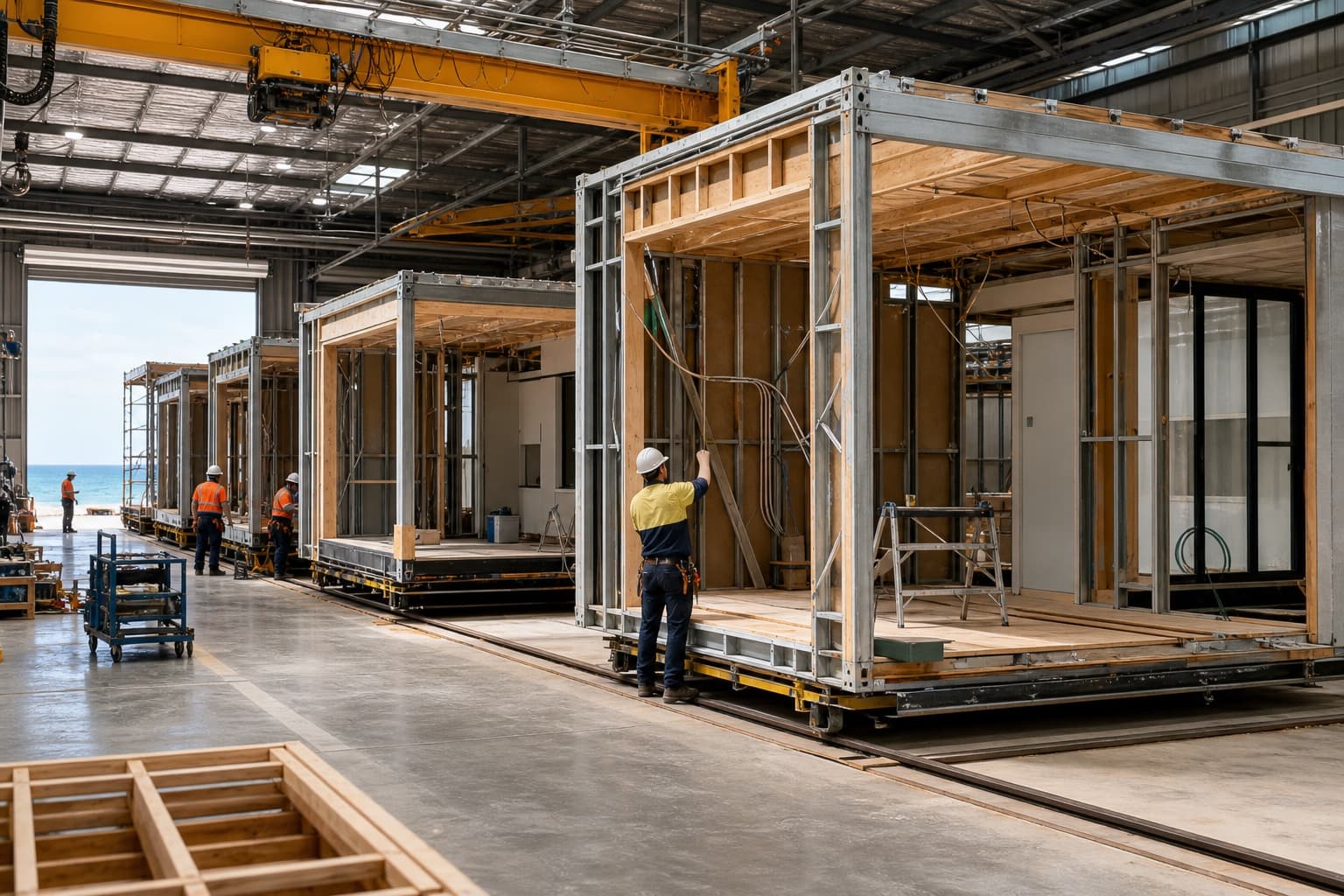
The National Reconstruction Fund has committed $120 million to Built Living, a joint venture planning an advanced apartment manufacturing facility at Neerabup in Western Australia.
The federal announcement on 24 August 2026 describes a $240 million funding package. It combines the new federal commitment, up to $100 million of staged Wesfarmers equity and about $20 million of earlier Western Australian Government support.
The venture says the facility is intended to make more than 2,000 apartments a year once operating at capacity. It aims to reduce construction costs by up to 20% and delivery time by up to 50% compared with conventional methods. Those figures are project targets, not measured results from a completed factory.
No tax, duty, mortgage or borrowing formula changed because of this announcement.
What changed on 24 August
The joint venture and WA support were announced in May. The new development is the National Reconstruction Fund commitment.
The published funding components are:
| Contributor | Published commitment | Important limit |
|---|---|---|
| National Reconstruction Fund | $120 million | Described as an investment, with the instrument type not stated in the media release |
| Wesfarmers | Up to $100 million | Staged equity announced in May |
| WA Government | About $20 million, plus land and infrastructure support | Earlier state package includes an incentive payment and project support |
| Total described package | $240 million | Mixes public investment, private equity and state support |
Calling all $240 million a government grant would be inaccurate. The federal release calls the $120 million component an investment. Wesfarmers describes its contribution as staged equity.
What the facility is intended to do
Built Living plans to manufacture components for medium and high-density apartment projects. The partners say the approach will use advanced manufacturing and standardised processes to move more work into a controlled factory setting.
The stated goals include:
- annual capacity above 2,000 apartments once fully operational;
- construction costs up to 20% lower;
- project delivery up to 50% faster; and
- about 150 construction jobs and 150 ongoing jobs.
Capacity is not the same as completed or occupied homes. A factory can have the ability to produce components for a stated number of apartments without every project being approved, financed, built and settled in that year.
The cost and time figures should also be read as aims. The sources do not provide completed-project evidence showing that every apartment will be 20% cheaper or delivered in half the time.
Timeline and approvals
The federal announcement says factory construction is expected to start in the second half of 2026.
The WA Government's May announcement gave an early 2028 completion target, subject to approvals, with production ramp-up expected in 2028-29. The sources do not announce specific apartment sites, sale prices, tenure, buyer eligibility or a schedule for completed dwellings.
That means the project can be relevant to the housing supply pipeline without being treated as current housing stock.
Read the August National Housing Accord progress update for the distinction between approvals, construction and completions.
What it means for a property estimate
The announcement does not justify reducing an entered property price or construction quote by 20%.
Future savings may be shared between manufacturers, developers, builders, financiers and buyers in different ways. Site works, planning, design, transport, installation, finance, taxes, selling costs and the local land price can still affect the final apartment price.
Use the Property Purchase Cost Calculator with the actual contract price and current state assumptions. Use the Mortgage Repayment Calculator with the lender rate, loan amount and term being considered. Neither tool uses the factory's cost target.
What remains uncertain
- The federal release does not state whether the National Reconstruction Fund investment is debt, equity or another instrument.
- Construction and early 2028 completion depend on approvals and project execution.
- Full manufacturing capacity may take time after the factory opens.
- The cost and speed claims are targets, not guaranteed outcomes.
- The number, location, tenure and sale price of apartments using the system are not announced.
- Manufacturing capacity does not establish the number of dwellings completed in a particular year.
Sources
- Australian Government: $240 million boost for Australia's housing supply, published 24 August 2026 and checked 25 August 2026.
- WA Government: Advanced manufacturing facilities to boost housing supply, published 5 May 2026 and checked 25 August 2026.
- Wesfarmers: Built Living joint venture announcement, published 4 May 2026 and checked 25 August 2026.
General information disclaimer
This article provides general information about announced project funding and stated manufacturing targets. It is not a property price forecast, construction quote, investment recommendation, housing eligibility assessment, financial advice or legal advice. Project timing, capacity, costs and delivery can change. Check current project and government sources before relying on the announcement.
Last updated: 25 August 2026.
Frequently asked questions
How much is the National Reconstruction Fund investing?
The federal announcement states a $120 million investment. It does not identify the instrument as a grant or a loan.
Will the factory produce 2,000 completed apartments every year?
Not necessarily. More than 2,000 apartments a year is the stated manufacturing capacity once fully operational. Capacity is not the same as approved, completed or occupied dwellings.
Will apartments be 20% cheaper?
The venture aims for construction costs up to 20% lower. It is not a guarantee about construction costs or final sale prices for every project.
Did the announcement change a RealEstateCalc formula?
No. It did not change a tax, duty, mortgage, borrowing or purchase-cost rule.
RealEstateCalc Editorial
Property & Finance ResearchThe RealEstateCalc editorial team researches and writes about Australian property, finance, and tax topics. All content is fact-checked against official sources including the ATO, state revenue offices, ASIC Moneysmart, and the RBA.
Related Calculators

Property Purchase Cost Calculator
Estimate the total upfront costs of buying property in Australia, including stamp duty, government fees, legal costs, inspections, insurance, and moving expenses.
PropertyMortgage Repayment Calculator
Calculate mortgage payments, total interest, and view an amortisation schedule for your home loan.
FinanceRelated Articles
Council Projects Housing Accord Target for Late 2030
The National Housing Supply and Affordability Council now projects the 1.2 million-home Accord target will be reached in the December quarter 2030. See the state progress and data limits.
Building Approvals vs Commencements and Completions in Australia
A practical guide to Australian housing supply data: what building approvals, dwelling commencements, work under construction and completions each measure.
How Long Does It Take to Build a House in Australia?
A practical Australian house-build timeline from preconstruction to handover, with common delay causes and a worked example of rent and build-stage interest costs.
Ready to try the Property Purchase Cost Calculator?
Use the calculator to model an indicative estimate from the assumptions you enter.
What moved in Australian property this week — in your inbox Sunday.
RBA decisions, clearance rates, policy shifts and the calculators that dropped. Two-minute read, no filler.
Free. No spam. Unsubscribe anytime.