June Quarter Housing Starts Rose 7.0%, Completions Rose 5.8%
The ABS October release records more dwelling starts and completions in the June quarter. Keep national supply statistics separate from a particular build timetable.
Try the Mortgage Repayment Calculator
Run the numbers while you read and see how the concepts apply to your situation.
What changed
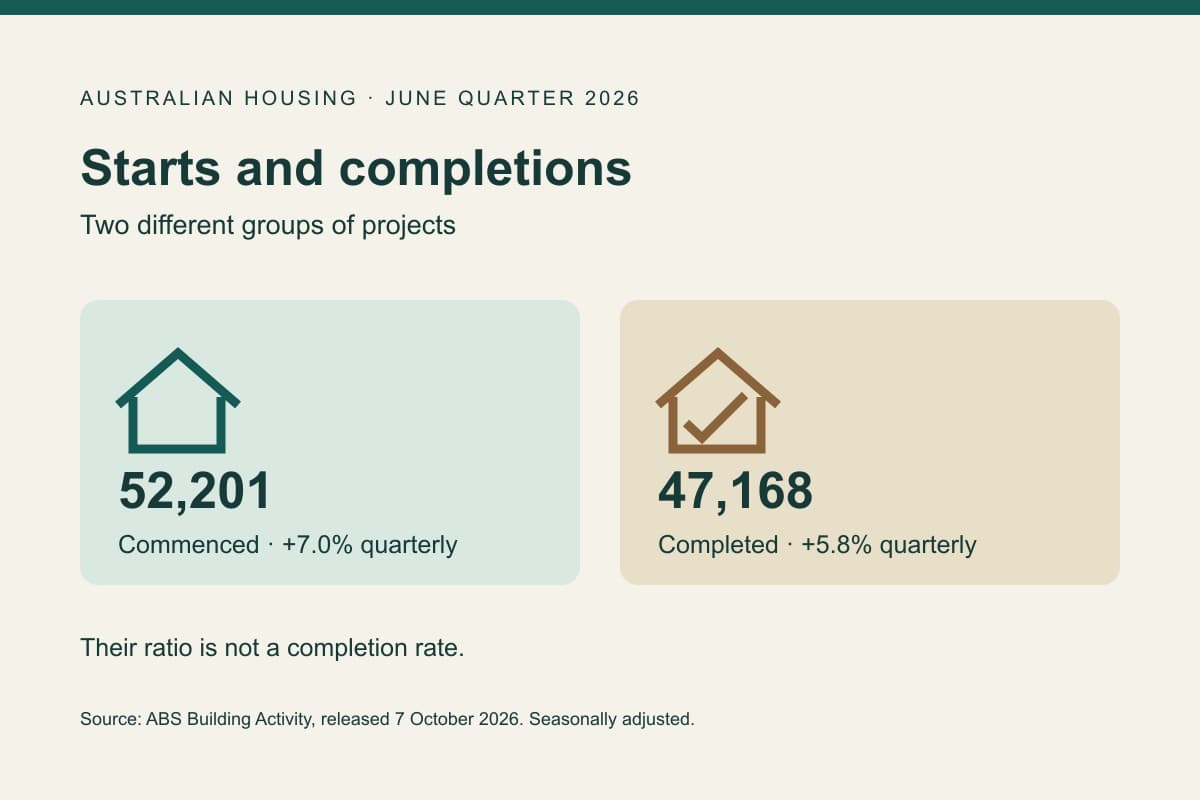
Australia recorded 52,201 dwelling commencements and 47,168 completions in the June quarter 2026, seasonally adjusted. Those were increases of 7.0% and 5.8% respectively from the March quarter. The ABS published the figures on 7 October 2026.
These are two different flows through the housing pipeline. They do not say that the homes started in June were also completed in June. The housing pipeline guide explains the stages.
The release in four numbers
| Measure | June quarter 2026 | Change from March quarter |
|---|---|---|
| All dwelling commencements, seasonally adjusted | 52,201 | +7.0% |
| All dwelling completions, seasonally adjusted | 47,168 | +5.8% |
| All dwelling commencements, trend | 51,421 | -0.2% |
| All dwelling completions, trend | 46,197 | +1.8% |
The trend and seasonally adjusted series tell different short-term stories about starts. Choose the series before quoting a change, and keep that choice consistent. ABS estimates are subject to revision.
Source: ABS Building Activity, Australia, June 2026, checked 9 October 2026. The reference quarter ended in June; October is the publication month.
Why the difference is not a completion rate
Dividing 47,168 by 52,201 gives roughly 90.4%. That arithmetic does not mean 90.4% of June's starts were finished during the quarter. The numerator and denominator describe different sets of projects.
A small hypothetical example makes the problem clearer. Suppose a builder starts ten homes this quarter and finishes eight homes that began last year. Eight divided by ten is 80%, but it tells us nothing about how far the ten new homes have progressed. A genuine completion-time analysis needs dates for the relevant projects.
For the same reason, subtracting national completions from starts is not a personal construction-delay estimate. Do not turn the headline rise into a shorter rent allowance, a new handover date or an assumed change in a builder's price.
Who may find this useful?
Buyers comparing established and newly built homes, renters following housing supply, and households arranging a build can use the release as national context. An individual budget still needs information from the actual contract, lender and project.
Three questions are more useful for a build budget:
- What is the current documented timetable, and which milestones remain uncertain?
- How much has already been drawn from the loan, and when is the next payment expected?
- Which accommodation and ownership bills continue if handover moves?
The construction drawdown interest worksheet shows how a payment halfway through a month changes an illustrative interest estimate. The build timeline and delay-cost guide covers ongoing costs if the timetable shifts.
Calculator impact
No mortgage, duty or buying-cost formula changes follow from these activity figures. The Mortgage Repayment Calculator can estimate a completed loan's regular repayments using entered assumptions. It does not infer a build schedule from ABS data or simulate construction drawdowns.
The Property Purchase Cost Calculator helps organise upfront purchase allowances; it does not quote construction costs. Use current project quotes and relevant authority information when updating those allowances.
What remains uncertain?
The release does not establish how many suitable homes are available in a particular suburb, a buyer's settlement date, future rents or future property prices. Comparing it with monthly dwelling approvals also requires different reference periods and pipeline stages to be kept separate.
The figures may be revised. This article makes no claim that one quarter establishes a lasting change or that a particular government measure caused it.
Sources and limitations
ABS Building Activity, June 2026, released 7 October 2026, checked 9 October 2026. The percentage-ratio example and ten-home illustration are original arithmetic used to explain a comparison error, not extra market observations.
General information only, not financial, credit, legal, tax or investment advice, a valuation, building assessment or forecast. Check project details with the relevant professionals before relying on a budget.
Last updated: 9 October 2026.
Frequently asked questions
Were 47,168 of the homes started in June also completed that quarter?
The figures do not establish that. They count starts and completions during the quarter, rather than following the same group of homes. Their ratio is not a cohort completion rate.
Should a national increase in housing starts change my build budget?
It does not establish a personal timetable or price. Use the actual project milestones, drawn loan balance, payment dates and current quotes.
RealEstateCalc Editorial
Property & Finance ResearchThe RealEstateCalc editorial team researches and writes about Australian property, finance, and tax topics. All content is fact-checked against official sources including the ATO, state revenue offices, ASIC Moneysmart, and the RBA.
Related Calculators

Mortgage Repayment Calculator
Calculate mortgage payments, total interest, and view an amortisation schedule for your home loan.
FinanceProperty Purchase Cost Calculator
Estimate the total upfront costs of buying property in Australia, including stamp duty, government fees, legal costs, inspections, insurance, and moving expenses.
PropertyRelated Articles
Building Approvals vs Commencements and Completions in Australia
A practical guide to Australian housing supply data: what building approvals, dwelling commencements, work under construction and completions each measure.
Construction Loan Interest: A Part-Month Drawdown Worksheet
Estimate interest when a construction loan drawdown happens partway through a month. Track dates, drawn balances and rates without charging undrawn funds.
Australian Dwelling Approvals Fell 6.1% in August 2026
ABS dwelling approvals fell to 16,953 in August 2026. Detached house approvals rose while other private dwellings fell. What the split means for reading supply data.
Ready to try the Mortgage Repayment Calculator?
Use the calculator to model an indicative estimate from the assumptions you enter.
What moved in Australian property this week — in your inbox Sunday.
RBA decisions, clearance rates, policy shifts and the calculators that dropped. Two-minute read, no filler.
Free. No spam. Unsubscribe anytime.