Construction Loan Interest: A Part-Month Drawdown Worksheet
Estimate interest when a construction loan drawdown happens partway through a month. Track dates, drawn balances and rates without charging undrawn funds.
Try the Mortgage Repayment Calculator
Run the numbers while you read and see how the concepts apply to your situation.
Short answer
For an illustrative daily-interest construction loan, split the month whenever the interest-bearing balance or rate changes. Calculate each interval separately, then add the amounts before rounding. Using the end-of-month balance for every day can overstate interest after a mid-month drawdown.
Interval interest = drawn balance x annual rate as a decimal x days / day-count divisor.
This worksheet uses 365 as an explicit assumption. It is not a lender statement reconstruction or a loan quote. The Mortgage Repayment Calculator is useful for a regular repayment scenario after construction; it does not model the dated drawdowns below.
Why the date matters
ANZ's construction loan handbook describes interest calculated daily on the balance owing and charged monthly. Its progress-payment guide distinguishes money drawn from the approved amount still available.
Those are lender examples, not a universal contract. Confirm the account's effective transaction dates, interest basis and repayment conditions. CBA's home loan support page gives an example of an annual rate divided by 365, including leap years. That does not establish another lender's day-count rule.
For the broader invoice and lender process, start with construction loans and progress payments. This page focuses on the arithmetic inside one statement period.
Worked example: a drawdown on 15 October
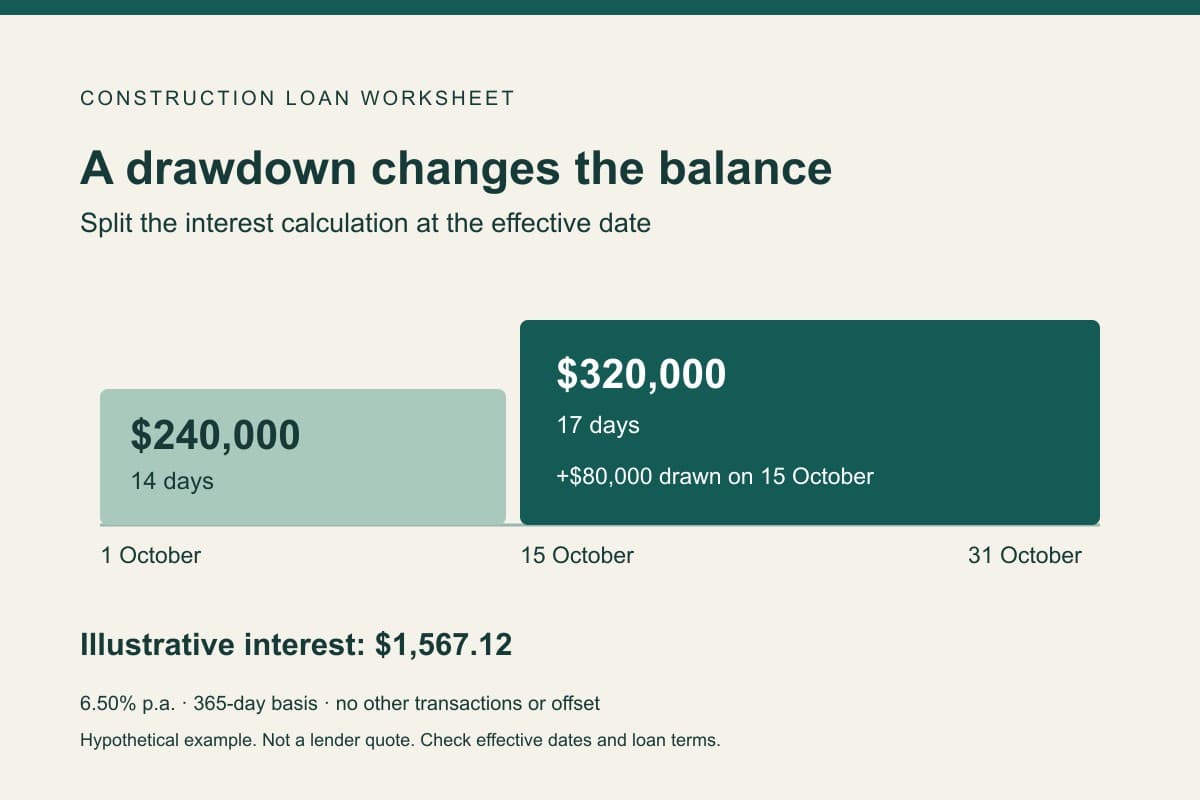
Assume an invented loan has $240,000 already drawn on 1 October. A further $80,000 is drawn with an effective date of 15 October, taking the balance to $320,000. Assume:
- A constant 6.50% annual rate and a 365-day divisor.
- The new balance applies for interest from 15 October, inclusive.
- No offset, principal repayment, fee, capitalised interest or other transaction during the month.
- Interest is paid separately at the end, so it does not increase the balances used below.
These figures are illustrative, not a product rate, standard progress schedule or loan approval.
| Interest interval | Days | Balance | Calculation | Interest estimate |
|---|---|---|---|---|
| 1 to 14 October inclusive | 14 | $240,000 | $240,000 x 0.065 x 14 / 365 | $598.36 |
| 15 to 31 October inclusive | 17 | $320,000 | $320,000 x 0.065 x 17 / 365 | $968.77 |
| Total | 31 | Add before rounding | $1,567.12 |
The two displayed rows add to $1,567.13 because each has already been rounded. The total uses unrounded interval amounts. Lender rounding may differ.
Using $320,000 for all 31 days gives $1,766.58, overstating this scenario by $199.45 before rounding. Dividing the final annual interest by 12 is another shortcut: it ignores both the first balance and October's day count.
If the approved facility were $500,000, the undrawn $180,000 at month end would not enter this example's interest calculation. Fees on the facility, if any, belong in a separate cost line.
A second way to check the answer
Keep the original $240,000 outstanding for all 31 days, then add interest on only the extra $80,000 for 17 days:
($240,000 x 0.065 x 31 / 365) + ($80,000 x 0.065 x 17 / 365) = $1,567.12.
This gives the same total as the interval table. It is a useful check when there is one new drawdown and no repayment. For several transactions, an interval or daily ledger is easier to follow.
Build a dated ledger
| Field to record | What to check |
|---|---|
| Opening drawn balance | Include any land borrowing already in this account; do not count it twice |
| Transaction effective date | Use the lender's date for interest, which may differ from the invoice date |
| Amount drawn or repaid | Distinguish new borrowing from a payment that reduces principal |
| Balance after transaction | Carry the updated balance into the next interval |
| Rate and effective date | Start a new interval if the rate changes, even with no drawdown |
| Days in interval | Cover every day once, with no gap or overlap |
| Fees and interest charges | Keep separate; if added to the loan, account for their effect on later balances |
If the new funds were drawn ten days earlier, the additional interest in this simplified example would be $142.47: $80,000 x 0.065 x 10 / 365. That isolates borrowing timing. It says nothing about when a builder must be paid or whether delaying payment is permitted. Follow the contract and obtain advice where needed.
Limits that matter in a real account
An offset, extra repayment, different day-count rule, rate change or capitalised charge changes the calculation. The month may not match the statement's charging period. Verify the start and end dates before comparing totals.
An interest-only amount does not reduce principal. After construction, use the lender's actual remaining repayment term and repayment type when checking the next payment. See the remaining loan term guide and mortgage statement worksheet.
This ledger is one component of a build budget. Keep rent, insurance, rates, storage and variations separate; the build-delay cost guide helps organise those costs. National dwelling starts and completions figures do not determine an individual loan's drawdown dates.
Sources and limitations
- ANZ construction loan handbook: daily interest and monthly charging example.
- ANZ progress-payment guide: drawn funds and progress payments.
- CBA home loan customer support: a lender example of a 365-day divisor.
Sources checked 9 October 2026. All dollar examples are original hypothetical arithmetic. No lender product is recommended and no standard construction timetable is assumed.
General information and indicative estimates only, not financial, credit, legal, tax or investment advice, a quote, approval or interpretation of a building contract. Confirm the account method with the lender and seek licensed advice for personal decisions.
Last updated: 9 October 2026.
Frequently asked questions
Can I use the final construction loan balance for the whole month?
That can overstate an estimate if more funds were drawn during the month. Divide the period at each effective balance or rate change and calculate each interval.
Is a builder invoice date the date interest starts on a drawdown?
Not necessarily. Use the lender effective transaction date and confirm how it is treated for daily interest. The invoice and drawdown may happen on different dates.
RealEstateCalc Editorial
Property & Finance ResearchThe RealEstateCalc editorial team researches and writes about Australian property, finance, and tax topics. All content is fact-checked against official sources including the ATO, state revenue offices, ASIC Moneysmart, and the RBA.
Related Calculators

Mortgage Repayment Calculator
Calculate mortgage payments, total interest, and view an amortisation schedule for your home loan.
FinanceProperty Purchase Cost Calculator
Estimate the total upfront costs of buying property in Australia, including stamp duty, government fees, legal costs, inspections, insurance, and moving expenses.
PropertyRelated Articles
Construction Loans in Australia: Progress Payments and Drawdowns
Understand how construction loan drawdowns, progress payments and build-stage interest can work, with a practical Australian example and clear lender and contract limitations.
Mortgage Statement Worksheet: Why Did the Balance Change?
Reconcile a mortgage statement using opening balance, interest, fees, redraw and payments. A worked Australian dollar example explains why payments exceed debt reduction.
June Quarter Housing Starts Rose 7.0%, Completions Rose 5.8%
The ABS October release records more dwelling starts and completions in the June quarter. Keep national supply statistics separate from a particular build timetable.
Ready to try the Mortgage Repayment Calculator?
Use the calculator to model an indicative estimate from the assumptions you enter.
What moved in Australian property this week — in your inbox Sunday.
RBA decisions, clearance rates, policy shifts and the calculators that dropped. Two-minute read, no filler.
Free. No spam. Unsubscribe anytime.