Australian Housing Credit Growth Eased to 0.4% in August 2026
The RBA reported housing credit growth of 0.4% in August and 7.3% over the year. These measure credit growth, not the interest rate charged on a mortgage.
Try the Mortgage Repayment Calculator
Run the numbers while you read and see how the concepts apply to your situation.
What changed
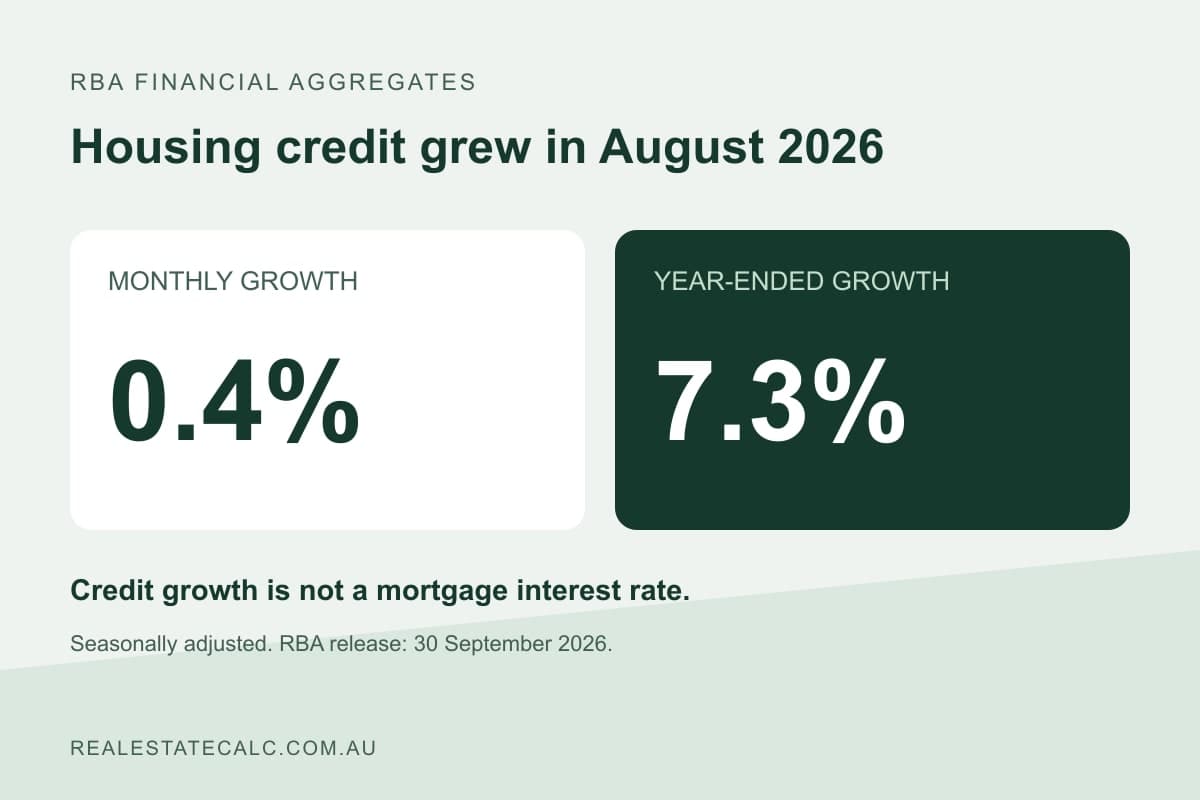
Australian housing credit grew 0.4% in August 2026, compared with 0.5% in July, according to the RBA's Financial Aggregates release published on 30 September 2026. Housing credit was 7.3% higher over the year to August, compared with 6.1% over the year to August 2025.
The monthly pace eased; housing credit still increased. Neither 0.4% nor 7.3% is a mortgage interest rate. Use the account rate from a lender notice when entering a scenario in the Mortgage Repayment Calculator.
The figures and their periods
| Measure | Published growth |
|---|---|
| Housing credit, July 2026 monthly | 0.5% |
| Housing credit, August 2026 monthly | 0.4% |
| Housing credit, year to August 2026 | 7.3% |
| Total credit, August 2026 monthly | 0.6% |
Source: RBA Financial Aggregates, August 2026, checked 7 October 2026. The release's growth figures are seasonally adjusted and account for breaks in the series. Historical observations can be revised. The RBA cautions against deriving growth rates from the unadjusted credit levels.
A slower increase is not a fall
Here is a hypothetical arithmetic example, not an estimate of Australia's credit balance. Suppose an index starts at 100 and rises 0.5% in one month, then 0.4% in the next:
- After the first month: 100 x 1.005 = 100.5.
- After the second month: 100.5 x 1.004 = 100.902.
The second increase is smaller, but the index continues to rise. Calling that sequence a fall in the amount of credit would confuse the pace of growth with the direction of the balance.
Likewise, multiplying August's 0.4% by 12 gives 4.8%, not the published 7.3% year-ended result. Those calculations answer different questions. A twelve-month observation includes the other eleven months; a one-month scenario cannot replace it.
Who can use this release?
Buyers, mortgage holders and readers tracking housing finance can use the release as background context. For the distinction between the credit stock and new lending activity, see housing credit versus new home loans. The July release summary preserves the previous month's reporting context.
This data does not establish a particular property's value, the repayment on a loan, or whether a lender will approve an application. An individual budget needs the loan balance, actual rate, remaining term, fees and repayment arrangement.
What changes in the calculators?
No formula or default-rate change follows from this release. Housing credit growth is not an input to the repayment formula. It should not replace a quoted home loan rate in a repayment or loan-comparison scenario.
For a practical account check, use the rate-change checklist. When comparing loan costs, include annual charges using the home loan package fee worksheet and the Loan Comparison Calculator.
What remains uncertain?
The August reference period does not describe October lending activity. The release cannot tell a reader how their lender will price a particular loan next month. This article makes no forecast for future rates, borrowing approvals or property prices.
Sources and limitations
- RBA: Financial Aggregates, August 2026, released 30 September 2026, checked 7 October 2026.
- The index example is original illustrative arithmetic, not a published economic series.
General information only, not financial, credit, legal or tax advice, a lending assessment, valuation or investment recommendation. Check current lender information before relying on a repayment estimate.
Last updated: 7 October 2026.
Frequently asked questions
Did housing credit fall in August 2026?
The RBA reported a 0.4% monthly increase. Growth slowed from July, but a positive growth rate still means an increase.
Should I use housing credit growth as my mortgage calculator rate?
No. Use the interest rate applicable to the loan. Credit growth measures a change in credit, not the interest charged on an account.
RealEstateCalc Editorial
Property & Finance ResearchThe RealEstateCalc editorial team researches and writes about Australian property, finance, and tax topics. All content is fact-checked against official sources including the ATO, state revenue offices, ASIC Moneysmart, and the RBA.
Related Calculators

Mortgage Repayment Calculator
Calculate mortgage payments, total interest, and view an amortisation schedule for your home loan.
FinanceLoan Comparison Calculator
Estimate two home loans using monthly repayments, interest and entered fees. Compare equal amounts and terms, or see the cost of changing a scenario.
FinanceRelated Articles
Housing Credit vs New Home Loans: How to Read Australian Lending Data
A practical guide to the difference between RBA housing credit, ABS new loan commitments, refinancing, loan counts and home loan interest rates.
Australian Housing Credit Growth Eased to 0.5% in July 2026
The RBA July 2026 credit release shows slower monthly housing debt growth. Read the figures alongside a household repayment example and the limits of the data.
Home Loan Package Fee: A Break-Even Worksheet
Compare a home loan rate discount with an annual package fee using a transparent worked example. Check the actual alternative rate, balance and extra costs.
Ready to try the Mortgage Repayment Calculator?
Use the calculator to model an indicative estimate from the assumptions you enter.
What moved in Australian property this week — in your inbox Sunday.
RBA decisions, clearance rates, policy shifts and the calculators that dropped. Two-minute read, no filler.
Free. No spam. Unsubscribe anytime.