Home Equity vs Net Sale Proceeds: What Is Left After Selling?
See why home equity differs from the cash left after a property sale. Work through selling costs, lender payout and a lower-price scenario in Australian dollars.
Try the Home Equity and LVR Calculator
Run the numbers while you read and see how the concepts apply to your situation.
Short answer
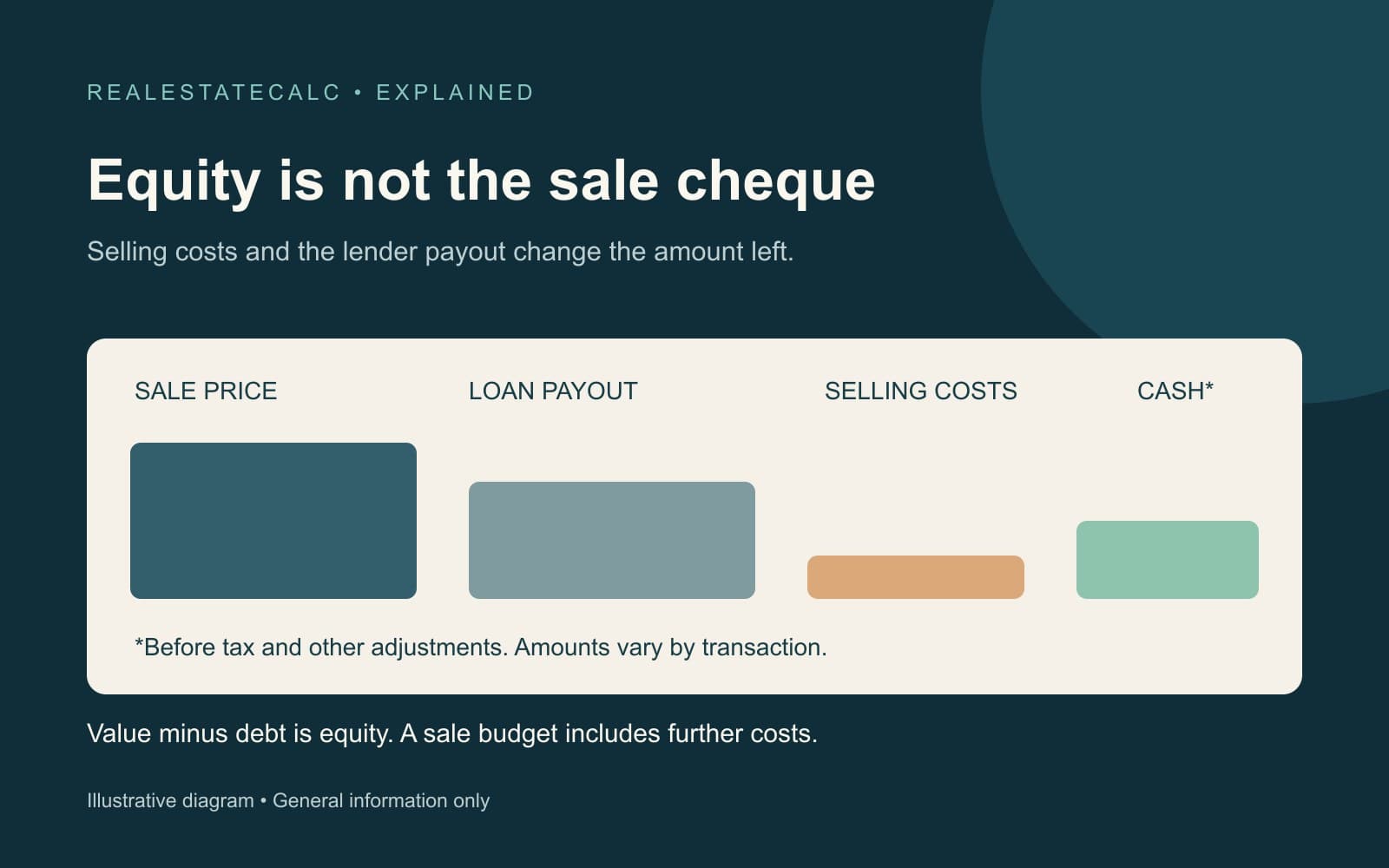
Home equity is the estimated property value less the debt secured against it. Net sale proceeds depend on the achieved sale price, selling costs, lender payout and any other amounts that must be accounted for. Equity and cash left after selling are different figures. Neither is automatically profit.
Use the Property Selling Cost Calculator to itemise sale expenses. Keep the result labelled before or after loan payout, and allow separately for tax and settlement adjustments that the tool does not calculate.
Start with two separate calculations
ASIC Moneysmart defines home equity as the home's value less what is owed on it. For a simple property with one loan, that can be written as:
Indicative equity = estimated property value minus secured loan balance.
A simplified sale budget uses a different set of inputs:
Cash after selling costs and loan payout = assumed sale price minus selling costs minus lender payout.
The second calculation is incomplete if tax, other secured debts or settlement adjustments also need to be paid. It is a budgeting subtotal, not the final settlement statement.
Worked example: $250,000 equity is not $250,000 cash
Assume an owner uses $800,000 as both the current value estimate and the possible sale price. The loan balance is $550,000, so mathematical equity is $250,000.
For this invented example, the expected lender payout is $552,000. That is a separate assumed figure, not a rule that payouts are always $2,000 above balances. Obtain the actual amount and inclusions from the lender for the intended date.
| Sale budget item | Illustrative amount |
|---|---|
| Assumed sale price | $800,000 |
| Agent commission: assumed 2.2%, including GST | -$17,600 |
| Marketing | -$3,000 |
| Conveyancing and other sale costs | -$2,400 |
| Proceeds before loan payout and tax | $777,000 |
| Assumed lender payout | -$552,000 |
| Cash subtotal before tax and settlement adjustments | $225,000 |
Selling costs total $23,000. The cash subtotal is $25,000 below the original $250,000 equity estimate: $23,000 of selling costs plus the $2,000 difference between the assumed payout and starting loan balance.
All example charges are invented, GST-inclusive where applicable and counted once. They are not typical fees, quotes or recommended commission rates. Any discharge charge included in the payout must not also be entered as a separate selling cost.
Test a lower sale price using the same assumptions
Now assume a $760,000 sale. Keep the 2.2% GST-inclusive commission, $5,400 of other sale costs and $552,000 payout unchanged.
- Commission becomes $16,720.
- Total selling costs become $22,120.
- Cash subtotal becomes $760,000 minus $22,120 minus $552,000 = $185,880.
The sale price is $40,000 lower, while the cash subtotal is $39,120 lower because percentage commission falls by $880. Fixed costs have not changed in this simplified scenario.
If the commission is a fixed amount or a tiered agreement, replace the percentage calculation with the actual terms. If settlement moves, also refresh the payout and other date-sensitive figures.
Positive equity can still leave a sale shortfall
Suppose a property's assumed sale price is $600,000, secured debt and payout are both $590,000, and selling costs are $20,000. Mathematical equity is positive $10,000, but the simplified sale subtotal is negative $10,000.
This arithmetic identifies a funding gap. It does not establish whether a lender will release its security or how the shortfall can be resolved. Discuss a possible shortfall with the lender and conveyancer or solicitor before relying on the estimate.
The Home Equity and LVR Calculator answers the initial value-and-debt question. The Property Value Change Calculator tests an entered value movement. Neither supplies an achieved sale price.
Replace the estimate with settlement information
The Law Society of NSW's settlement guidance explains that the amount owing to the lender is established for mortgage discharge and that settlement can include adjustments. Its guidance is NSW-specific; obtain the process and figures for the property's jurisdiction from the person handling the conveyance.
A useful worksheet records the source and date for each input:
| Input | Evidence to obtain |
|---|---|
| Sale price | Contract or clearly labelled pre-sale assumption |
| Commission and marketing | Agency agreement and invoices, with GST basis |
| Legal and other charges | Current quotes and inclusions |
| Loan payout | Lender figure for the intended settlement date |
| Adjustments and remaining payments | Draft settlement statement and professional explanation |
The mortgage discharge guide covers that process in more detail. This page focuses on reconciling the numbers, not setting the legal order of payment.
Avoid three common budget mistakes
Do not add the buyer's deposit to the full sale price. In this worksheet, the full assumed sale price already includes that amount. The deposit's payment and release timing is a separate contract question for the conveyancer.
Do not label the remaining cash as investment profit. Loan principal, purchase costs, improvements, ownership expenses and tax are not reconciled here. A capital gain is also a separate tax calculation; this guide makes no tax determination.
Do not commit the whole subtotal to the next purchase. Put the next purchase's costs and timing in a separate worksheet. The Property Purchase Cost Calculator can help itemise an indicative acquisition budget, but it does not confirm when sale money will be available or whether finance will be approved.
Sources and limitations
- ASIC Moneysmart: Reverse mortgage and home equity release, used only for the equity definition, checked 3 October 2026. No equity-release product is recommended here.
- Law Society of NSW: Finalising the sale, checked 3 October 2026.
- All dollar scenarios and fee assumptions are original examples. They exclude tax, unlisted liabilities and settlement adjustments.
General information and indicative estimates only, not financial, legal, tax or credit advice, a quote, valuation, settlement statement or recommendation to sell. Shared-equity arrangements, multiple securities and ownership disputes require separate professional review and are outside these examples.
Last updated: 3 October 2026.
Frequently asked questions
Is home equity the amount left after selling?
No. A simple equity calculation uses estimated value less secured debt. A sale budget must also account for the achieved price, selling costs, lender payout and any relevant adjustments or tax.
Can selling costs exceed positive equity?
Yes. In the illustrative $600,000 sale with a $590,000 payout and $20,000 selling costs, there is a $10,000 funding shortfall despite $10,000 of mathematical equity.
Is the cash left after selling the same as profit?
No. That subtotal does not reconcile the original purchase cost, improvements, holding costs, loan principal and tax. It is not a capital gains tax calculation.
RealEstateCalc Editorial
Property & Finance ResearchThe RealEstateCalc editorial team researches and writes about Australian property, finance, and tax topics. All content is fact-checked against official sources including the ATO, state revenue offices, ASIC Moneysmart, and the RBA.
Related Calculators

Home Equity and LVR Calculator
Estimate total home equity, current loan-to-value ratio and equity above a chosen planning LVR using a property value and mortgage balance.
PropertyProperty Value Change and LVR Calculator
Convert a percentage property-value change into an indicative dollar value, equity position and loan-to-value ratio scenario.
PropertyProperty Purchase Cost Calculator
Estimate the total upfront costs of buying property in Australia, including stamp duty, government fees, legal costs, inspections, insurance, and moving expenses.
PropertyRelated Articles
Mortgage Discharge Fees and Process in Australia
Understand lender discharge fees, land-title registration charges and the mortgage release process when selling, refinancing or paying off an Australian home loan.
How to Calculate LVR for an Australian Home Loan
Calculate loan-to-value ratio from the loan amount and lender property value, with worked 80%, 90% and valuation-shortfall examples.
RBA October 2026 Review: Reading the Housing Equity Scenario
The RBA October Financial Stability Review tests a 20% housing-price fall. Understand the negative-equity estimate and why a scenario is not a forecast.
Ready to try the Home Equity and LVR Calculator?
Use the calculator to model an indicative estimate from the assumptions you enter.
What moved in Australian property this week — in your inbox Sunday.
RBA decisions, clearance rates, policy shifts and the calculators that dropped. Two-minute read, no filler.
Free. No spam. Unsubscribe anytime.