Try the Rental Yield Calculator
Run the numbers while you read and see how the concepts apply to your situation.
What changed
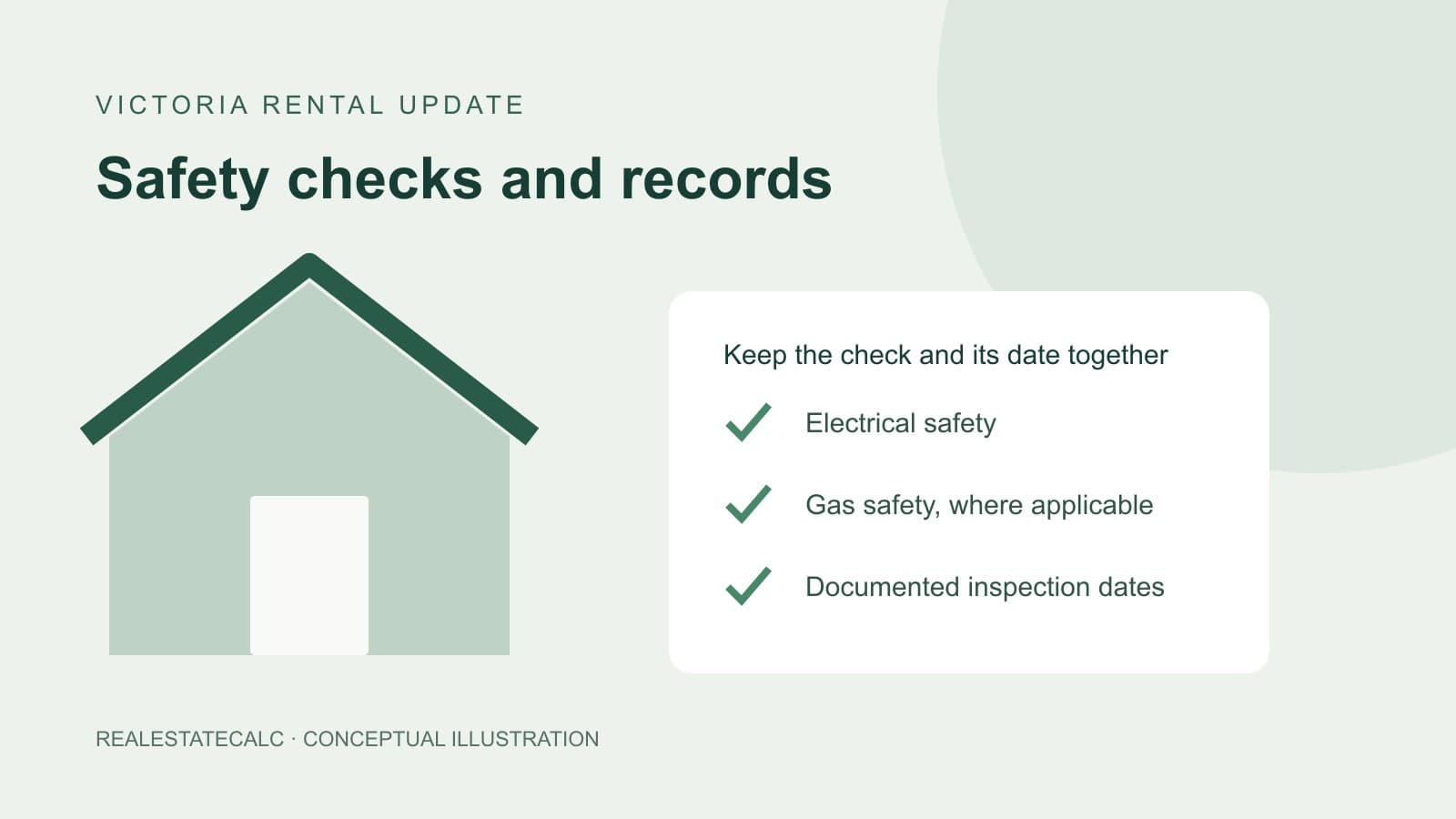
From 13 October 2026, Victoria's two-yearly gas and electrical safety-check requirement extends to all rental properties, including agreements that started before March 2021. Gas checks apply where the property has gas appliances, fixtures or fittings. Consumer Affairs Victoria (CAV) lists the change as in effect, not a future proposal.
The same update introduces stronger bond-claim notice and evidence requirements, rental minimum-standard records, and a ban on rental providers and agents charging application or rent-payment fees. Third-party businesses were already covered by an earlier fee ban. Source: CAV's current rental law changes.
Which date belongs in the diary?
October's safety-check change is separate from minimum energy-efficiency standards being phased in from 1 March 2027. The energy-efficiency standards guide covers those later triggers. Do not use a future upgrade date as the due date for a safety check.
CAV's gas and electrical safety guidance says checks must be completed by appropriately licensed or registered tradespeople. If a required check has not occurred within the previous two years when a renter moves in, it must be arranged as soon as possible.
For gas properties, a separate pre-draughtproofing check must occur within six months before the work begins. CAV says the two types of gas check may be combined in one visit if both sets of requirements are met. A routine check date alone does not settle whether proposed draughtproofing is safe.
A practical record for providers and renters
Create a separate row for each check rather than a single entry labelled “property compliant”. This original organising table is not an official compliance form.
| Record | What to enter | What still needs checking |
|---|---|---|
| Gas check | Actual check date and report reference, where applicable | Appropriate scope and any outstanding work |
| Electrical check | Actual check date and report reference | Report findings and follow-up actions |
| Proposed draughtproofing | Proposed work date and relevant assessment | Whether the work can proceed safely |
| Quote or invoice | Amount, scope, inclusions and payment date | Whether repairs are extra |
An unknown date should remain marked unknown until supported by a record. For older agreements, CAV explains that renters can request the last check dates. Ask the provider or agent for the relevant information and use the official guidance for the process.
A completed checklist is an information record. It cannot certify a home or replace a tradesperson's assessment. For a suspected safety problem, use CAV's safety and urgent-repair guidance; do not wait for a budgeting exercise or future routine check.
Worked example: a two-year cost is not a monthly invoice
Suppose a provider obtains an invented combined quote of $480 for scheduled checks. This is an arithmetic example, not a market price or a complete compliance budget.
Spreading that amount across 24 months gives $480 / 24 = $20 a month, or $240 a year. But if payment is due in four months and no money has been set aside, the amount needed for that invoice is $480 / 4 = $120 a month over those four months.
The annual average and the near-term cash requirement answer different questions. Both exclude repairs, additional visits, changed prices and other property costs. The annual and quarterly bills guide explains this timing distinction in more detail.
What changes in our calculators?
No mortgage, stamp duty or rental-yield formula changes follow from this announcement. The rule does not supply a universal dollar cost.
The Investment Property Yield Calculator can compare an explicitly labelled annual cost allowance using your own quotes and assumptions. Keep the actual invoice date in a separate cash budget. Neither a yield result nor an allowance establishes legal compliance or tax deductibility.
Renters planning a move can use the bond and moving cash-flow worksheet. Bond-claim evidence rules do not guarantee an immediate or full refund.
Sources and limits
Both linked CAV pages were updated on 13 October 2026 and checked on 14 October 2026. The official bond claims and refunds guidance explains that separate process. This article covers the current change and practical record keeping, not every rental obligation or property type. Prices, actual check history and remedial work remain property-specific.
General information only, not legal, financial, tax, building, property-management or investment advice. This is not a compliance determination or a safety certificate. Check the current official requirements and obtain advice from the relevant qualified professional.
Last updated: 14 October 2026.
RealEstateCalc Editorial
Property & Finance ResearchThe RealEstateCalc editorial team researches and writes about Australian property, finance, and tax topics. All content is fact-checked against official sources including the ATO, state revenue offices, ASIC Moneysmart, and the RBA.
Related Calculators

Rental Yield Calculator
Estimate gross and net rental yield from rent, purchase price, vacancy and annual costs. Add a loan to estimate pre-tax cash flow using interest-only costs.
PropertyRent-to-Income Ratio Calculator Australia
Estimate what share of gross household or individual income is used by rent, with annualised amounts and a clear explanation of the limits.
PropertyRelated Articles
Victoria’s Rental Energy Standards: What Starts in 2027
Victoria’s rental energy efficiency standards start in phases from March 2027. Check the separate triggers for heating, cooling, hot water, showerheads, insulation and draughtproofing.
Rental Move Budget: Bond and Cash-Flow Worksheet
Track when a new bond, rent and moving invoices are due. An original worksheet shows why a later bond refund cannot fund an earlier payment.
Ready to try the Rental Yield Calculator?
Use the calculator to model an indicative estimate from the assumptions you enter.
What moved in Australian property this week — in your inbox Sunday.
RBA decisions, clearance rates, policy shifts and the calculators that dropped. Two-minute read, no filler.
Free. No spam. Unsubscribe anytime.