Home Upgrade Rebate Cash Flow: Check the Gap Before Reimbursement
A rebate can reduce an assumed final cost without funding the invoice due today. Use a worked cash-flow worksheet to separate quoted discounts, reimbursements and money received.
Investor check
Compare yield, cash flow and tax together
A yield headline is only useful after vacancy, land tax, strata and interest are included.
Short answer
If a home upgrade requires payment before reimbursement, budget for the cash needed before the reimbursement arrives, as well as the final cost after it. An application, approval and bank receipt are different records. This worksheet assumes a reimbursement arrangement solely to show the arithmetic; it does not describe the payment rules of a particular grant.
Start with the renovation contingency budget guide for the total cost. Use this page to put the payments and assumed receipts in date order.
First establish how the assistance is paid
Do not infer payment mechanics from the word “rebate”. Ask the program administrator or supplier which arrangement applies and keep the written explanation with the quote.
| Arrangement to check | How to enter it in a worksheet |
|---|---|
| Discount already deducted from the supplier's quote | Use the net amount payable; do not deduct the same discount again |
| Reimbursement paid to the household later | Record the gross payment and a separate assumed receipt date |
| Payment made directly to a contractor | Confirm which part, if any, the household must pay; do not invent a cash receipt |
| Application still awaiting a decision | Keep a separate scenario without the assumed assistance |
This table is a recordkeeping framework, not a statement that any named program offers all four options. Check eligibility, approved scope, documentation, payment conditions and timing directly. An advertised maximum is not an approved amount for the project.
Worked example: $12,000 of work and an assumed $3,000 reimbursement
The amounts and payment sequence below are hypothetical. Assume the household has $10,000 of cash allocated to this project, a written $12,000 GST-inclusive works price, no borrowing, no interest, and no other payments or receipts. The example assumes a $3,000 reimbursement arrives after the supplier has been paid. It is not a current government offer or a permitted deposit schedule.
| Event | Cash paid | Cash received | Modelled project balance |
|---|---|---|---|
| Starting project funds | $0 | $10,000 | $10,000 |
| First agreed payment | $2,000 | $0 | $8,000 |
| Remaining agreed payment | $10,000 | $0 | -$2,000 |
| Later assumed reimbursement | $0 | $3,000 | $1,000 |
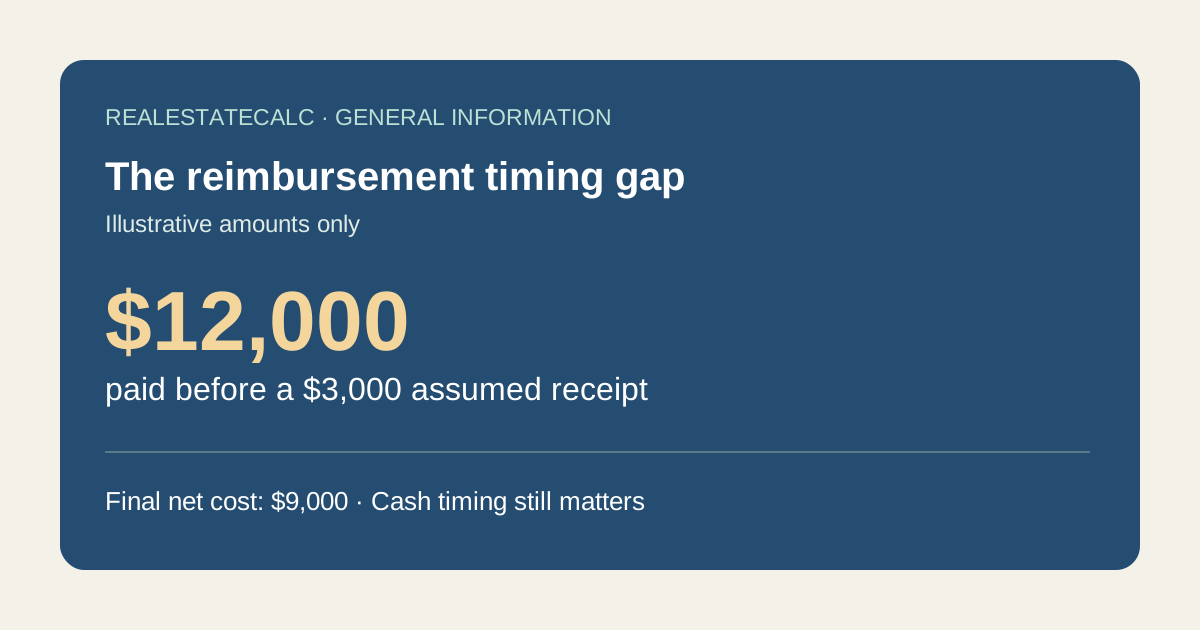
The final net project cost would be $12,000 - $3,000 = $9,000 under those assumptions. Yet the lowest modelled balance is -$2,000. That negative figure identifies an unfunded payment in the plan. It is not permission to overdraw an account or evidence that finance is available.
To keep this simplified schedule at or above zero, the arithmetic requires $12,000 of starting project cash, or another confirmed arrangement that resolves the timing gap. That is $2,000 more than the assumed starting funds. It excludes any separate household or project reserve.
Test a delay and a smaller payment
If the assumed reimbursement arrives six weeks later, the peak $2,000 gap stays the same in this simplified example, but lasts six weeks longer. Additional living costs, interest or other project payments would change that result; none is included here.
If only $2,000 is received, the final net project cost becomes $10,000 and the final project balance becomes $0. The earlier $2,000 gap remains. If nothing is received, the net cost stays $12,000 and the final balance stays at -$2,000 unless another confirmed source is added.
A different arrangement gives a different result. If a verified $3,000 discount is already included in a $9,000 net supplier invoice, recording a further $3,000 reimbursement would incorrectly reduce the project cost to $6,000. Reconcile the gross price, each discount and the actual amount payable before entering the numbers.
Keep a dated payment record
For each row, record the payer, recipient, amount, contractual due date or estimated receipt date, supporting document, and whether it is confirmed or assumed. Replace estimates with actual transactions as they occur. A claim submitted on Monday is not money received on Monday.
ASIC Moneysmart's budgeting guidance recommends recording income and expenses, including irregular costs, and checking how much is paid and when. Its household-budget approach supports keeping everyday bills alongside, but separate from, a project schedule.
Check contract questions with the relevant qualified professional. Do not defer an invoice, pay early or assume an extension on the basis of this worksheet.
Related calculations
If the work is attached to a purchase, keep the acquisition funds in the Property Purchase Cost Calculator separate so the deposit is not counted as available project cash. If independently considering a loan scenario, the Mortgage Repayment Calculator estimates repayments under entered assumptions; it does not establish access to short-term funding.
For subsequent running costs, the home energy upgrade payback worksheet considers assumed bill savings. Future bill savings are not a reimbursement available to pay today's invoice. Provider-delivered social housing works, including the October SHEPI milestone, should not be treated as the household reimbursement arrangement illustrated here.
Common questions
Does approval remove the timing gap? Not by itself. The worksheet needs the payment conditions and timing, not just an approved headline amount.
Is the lowest balance the amount I should borrow? No. It is a modelled gap under limited assumptions. It excludes financing costs, changes in scope and household circumstances and is not a credit recommendation.
Can I use the same schedule for every state? No. Replace the assumed arrangement with the actual program and contract records. This page contains no grant entitlement calculation.
Sources and limitations
Moneysmart guidance linked above checked 20 October 2026. The worksheet, amounts and sensitivity cases are original examples; no program payment rules or processing times have been assumed to be universal.
General information only, not financial, legal, tax, credit or investment advice, a funding approval, grant determination or recommendation to borrow. Check the relevant authority and appropriately qualified professionals before relying on a project funding plan.
Last updated: 20 October 2026.
RealEstateCalc Editorial
Property & Finance ResearchThe RealEstateCalc editorial team researches and writes about Australian property, finance, and tax topics. All content is fact-checked against official sources including the ATO, state revenue offices, ASIC Moneysmart, and the RBA.
Related Calculators

Property Purchase Cost Calculator
Estimate the total upfront costs of buying property in Australia, including stamp duty, government fees, legal costs, inspections, insurance, and moving expenses.
PropertyMortgage Repayment Calculator
Calculate mortgage payments, total interest, and view an amortisation schedule for your home loan.
FinanceRelated Articles
Renovation Contingency Budget: Keep the Reserve Separate
Build a renovation budget that separates quoted work, known extras and an unspent contingency reserve. Follow a transparent Australian dollar worked example.
Home Energy Upgrade Payback: A Quote and Savings Worksheet
Calculate simple payback from the cost you actually pay and an explicit annual cash saving. Check quote discounts, fixed charges and uncertain savings.
Ready to try the Property Purchase Cost Calculator?
Use the calculator to model an indicative estimate from the assumptions you enter.
What moved in Australian property this week — in your inbox Sunday.
RBA decisions, clearance rates, policy shifts and the calculators that dropped. Two-minute read, no filler.
Free. No spam. Unsubscribe anytime.