House Price Falls: Why a 10% Drop Needs an 11.11% Rise to Recover
Work through the different percentage bases after a property value falls. Compare value recovery with equity, selling costs and inflation using hypothetical Australian-dollar examples.
Try the Property Value Change and LVR Calculator
Run the numbers while you read and see how the concepts apply to your situation.
Short answer
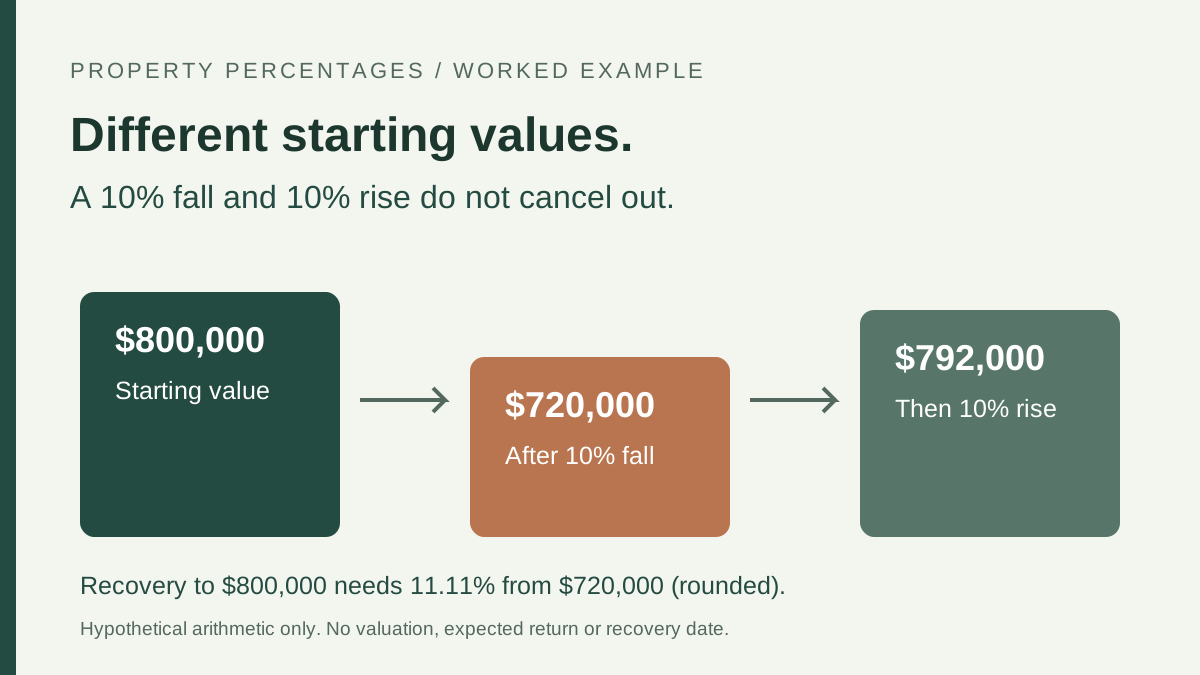
A 10% fall takes an assumed $800,000 property value to $720,000. Returning to $800,000 requires an $80,000 increase. That is 11.11% of $720,000, rounded to two decimal places. The fall and the rise use different starting values.
This is arithmetic, not a prediction that a home will regain its earlier value. ASIC Moneysmart notes that property can rise or fall in value, borrowing increases financial risk and selling can take time and be expensive.
Use the Property Value Change Calculator to test an assumed movement. The tool uses the value and percentage entered; it does not provide a valuation or a market forecast.
Work through the two steps
All figures below are hypothetical Australian dollars. No suburb, property or observed market movement is represented.
- Start with $800,000. A 10% fall is $80,000, leaving $720,000.
- Apply a 10% rise to $720,000. That rise is $72,000, giving $792,000.
- The value is still $8,000 below the original $800,000.
To reach the original value, divide the missing $80,000 by the new $720,000 base. The unrounded result is 11.111...%. Entering the rounded 11.11% into a calculator gives $799,992, so the remaining $8 is a rounding difference, not a formula error.
The formula and its limits
For an original value greater than zero and a fall of less than 100%:
Rise required (%) = fall (%) ÷ (100 − fall (%)) × 100
For a 20% fall, the calculation is 20 ÷ 80 × 100 = 25%. Equivalently, divide the original value by the lower value, subtract 1 and multiply by 100.
| Assumed fall | Value after fall from $800,000 | Rise needed to regain $800,000 |
|---|---|---|
| 5% | $760,000 | 5.26% |
| 10% | $720,000 | 11.11% |
| 20% | $640,000 | 25.00% |
| 30% | $560,000 | 42.86% |
| 50% | $400,000 | 100.00% |
Percentages in the last column are rounded. These scenarios show the relationship between a loss and a later gain. They are not expected falls, expected returns or forecasts of recovery time.
At a 0% fall, no rise is needed. At a 100% fall, the remaining value is zero and this percentage formula is undefined: there is no finite percentage increase from zero that restores a positive starting value. Negative original values and falls above 100% are outside this worksheet's property-value assumptions.
A price movement can have a larger effect on equity
Moneysmart's home equity explanation defines equity as the home's value less what is owed on it. That definition is used here; no equity-release product is recommended.
Assume an $800,000 value and a $600,000 loan balance. Initial equity is $200,000. If the value falls 10% to $720,000 while the loan remains $600,000, equity becomes $120,000. The $80,000 equity reduction is 40% of the original $200,000 equity.
| Snapshot | Property value | Assumed loan | Equity before selling costs | Loan-to-value ratio |
|---|---|---|---|---|
| Before fall | $800,000 | $600,000 | $200,000 | 75.00% |
| After 10% fall | $720,000 | $600,000 | $120,000 | 83.33% |
| Value returns to original level | $800,000 | $600,000 | $200,000 | 75.00% |
The loan is deliberately held constant to isolate the price effect. Actual repayments, extra borrowing, fees and interest capitalisation can change the balance. A lender's valuation may differ from the value used in this worksheet. The Home Equity and LVR Calculator lets you enter another debt-and-value snapshot; it does not establish available credit.
Regaining the price is not breaking even on ownership
Returning to an earlier dollar value does not recover every dollar spent. Purchase costs, interest, insurance, rates, maintenance and selling costs are outside the price-only calculation. Rental income and tax outcomes are also excluded.
If a hypothetical sale price is $800,000, the loan payout is $600,000 and selling costs are $25,000, the remaining amount before any other adjustments is $175,000. That differs from the $200,000 headline equity. The $25,000 is an invented assumption, not a fee benchmark. Our equity versus net sale proceeds guide expands that reconciliation.
Inflation is another separate question. If the general price level increased during the holding period, the same dollar value has less purchasing power. The Inflation Calculator tests an entered constant inflation assumption; it does not retrieve a home's historical real return.
Common questions
Does a 20% fall followed by a 20% rise cancel out?
No. Multiply 0.8 by 1.2 to get 0.96. The final value is 96% of the starting value, or 4% lower. For the $800,000 example, that is $768,000.
Can the formula say how long recovery will take?
No. It gives the increase needed from the lower base, without a date or probability. Values can fall further or never return to the earlier level. Do not turn a required increase into an expected return.
Is a city index the value of my property?
No. This worksheet has no property-specific valuation input beyond the figure you supply. Keep a market indicator, an asking price, a lender valuation and an achieved sale price labelled separately.
Sources, assumptions and limitations
The two ASIC Moneysmart pages linked above were checked 23 October 2026 for property-risk context and the equity definition. The percentage formula is derived from the ordinary percentage-change identity. All dollar examples and tables are original arithmetic, independently recalculated for this guide. They exclude holding periods, transaction timing and personal tax outcomes.
General information only, not financial, legal, tax, credit or investment advice, a valuation or a recommendation to buy, sell, hold or borrow. Speak with an appropriately licensed professional about personal decisions.
Last updated: 23 October 2026.
RealEstateCalc Editorial
Property & Finance ResearchThe RealEstateCalc editorial team researches and writes about Australian property, finance, and tax topics. All content is fact-checked against official sources including the ATO, state revenue offices, ASIC Moneysmart, and the RBA.
Related Calculators

Property Value Change and LVR Calculator
Convert a percentage property-value change into an indicative dollar value, equity position and loan-to-value ratio scenario.
PropertyHome Equity and LVR Calculator
Estimate total home equity, current loan-to-value ratio and equity above a chosen planning LVR using a property value and mortgage balance.
PropertyInflation Calculator Australia
Model how a constant assumed annual inflation rate changes an amount over time. This is a scenario tool, not a historical CPI lookup.
FinanceRelated Articles
Home Equity vs Net Sale Proceeds: What Is Left After Selling?
See why home equity differs from the cash left after a property sale. Work through selling costs, lender payout and a lower-price scenario in Australian dollars.
RBA October 2026 Review: Reading the Housing Equity Scenario
The RBA October Financial Stability Review tests a 20% housing-price fall. Understand the negative-equity estimate and why a scenario is not a forecast.
Ready to try the Property Value Change and LVR Calculator?
Use the calculator to model an indicative estimate from the assumptions you enter.
What moved in Australian property this week — in your inbox Sunday.
RBA decisions, clearance rates, policy shifts and the calculators that dropped. Two-minute read, no filler.
Free. No spam. Unsubscribe anytime.