Rate impact
Model repayments before the next rate move
Turn rate news into a repayment, borrowing-power or refinance scenario.
Short answer
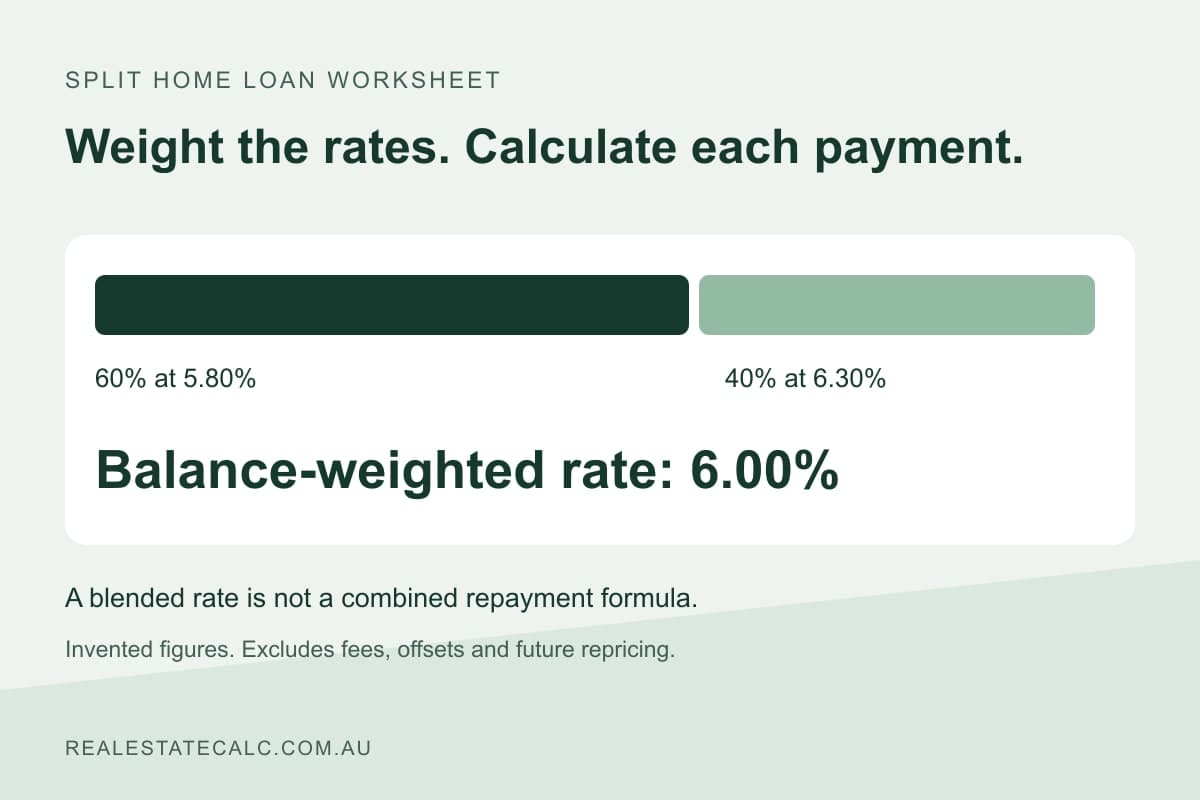
A split home loan's blended interest rate is a balance-weighted average. It can summarise the rates on the portions, but it does not replace their separate repayment calculations, fees, fixed-rate expiry dates or offset rules.
Blended rate = (first balance x first rate + second balance x second rate) / total balance.
Use the Mortgage Repayment Calculator once for each portion, keeping its own balance, rate and remaining term. Add the resulting repayments only after putting them on the same payment frequency.
What the split means
ASIC Moneysmart describes a partially fixed loan as one with a fixed-rate portion and a variable-rate portion. Its fixed versus variable guide explains that a fixed period normally ends with a move to a variable rate unless another arrangement is made. Fees and restrictions need checking separately.
This worksheet explains the arithmetic. It does not select a split percentage or say whether a fixed, variable or split arrangement suits a household.
Worked example: unequal balances
Assume a hypothetical $500,000 mortgage has these two portions. The figures are invented, not offers or market averages.
| Portion | Balance | Share of total | Annual rate |
|---|---|---|---|
| Fixed | $300,000 | 60% | 5.80% |
| Variable | $200,000 | 40% | 6.30% |
| Total | $500,000 | 100% | 6.00% blended |
The weighted calculation is (60% x 5.80%) + (40% x 6.30%) = 6.00%. Simply averaging 5.80% and 6.30% gives 6.05%, which incorrectly assumes equal balances.
At those unchanged balances, an illustrative year's simple interest is $17,400 + $12,600 = $30,000, the same as $500,000 x 6.00%. This identity explains the weighted average. It excludes repayments, compounding, offsets, fees and any rate change, so it is not an annual statement forecast.
Estimate each repayment separately
Now assume each portion is principal and interest, with 25 years remaining, monthly interest periods and payments at the end of each month. Hold the entered rates constant purely for calculating the current scheduled-payment estimates; this does not mean the fixed rate lasts 25 years.
| Portion | Monthly repayment estimate |
|---|---|
| $300,000 at 5.80% over 25 years | $1,896.39 |
| $200,000 at 6.30% over 25 years | $1,325.53 |
| Combined | $3,221.92 |
These use the standard monthly amortisation formula: payment = balance x monthly rate / (1 - (1 + monthly rate) raised to minus the number of payments). The monthly rate is the annual percentage divided by 1,200; the number of payments is 300. For a zero rate, divide the balance by the number of payments.
Putting the whole $500,000 into a calculator at 6.00% gives about $3,221.51 instead. The 41-cent difference is small in this example, but shows why the blended rate is a summary, not the combined repayment formula. Different terms or repayment types make the single-rate shortcut less useful.
When only the variable portion rises
Suppose the example's variable rate rises by 0.25 percentage points to 6.55%, while the fixed portion stays at 5.80% and both balances are unchanged.
The new blended rate is (60% x 5.80%) + (40% x 6.55%) = 6.10%. The combined rate rises by 0.10 percentage points because only 40% of the balance receives the 0.25 percentage point increase.
Under the same 25-year monthly-payment assumptions, the variable portion becomes $1,356.67 a month and the combined estimate becomes $3,253.06. The increase is about $31.14 per month, calculated before final display rounding. This is a scenario, not a lender's repayment notice.
The CBA October rate-notice timeline is a current example of why a rate effective date and a repayment-message date should be recorded separately.
Fill in the details a blended rate leaves out
| Field for each portion | Why to keep it separate |
|---|---|
| Current balance | Original split percentages may have changed after repayments |
| Account rate and expiry date | One portion may reprice while another remains fixed |
| Remaining term | A shorter term can require a larger payment at the same rate |
| Principal and interest or interest-only" class="glossary-link" data-glossary="interest-only">interest only | The two payment types reduce debt differently |
| Offset connection | Do not subtract one offset balance from both portions |
| Repayment frequency | Weekly and monthly amounts cannot simply be added |
| Fees and restrictions | A weighted interest rate is not a comparison rate |
Check which account a fee belongs to. A shared annual package fee should not be counted twice; the package fee worksheet explains the recurring-cost comparison. Check loan documents for offset access and fixed-rate break or extra-repayment conditions rather than assuming both portions work alike.
If both balances are zero, the weighted-rate division is undefined. Record no outstanding balance rather than displaying an interest rate. Negative balances, missing rates and differing currencies also fall outside this worksheet.
Related calculations and sources
- Mortgage Repayment Calculator: run separate scenarios for each portion.
- Loan Comparison Calculator: compare alternatives while checking fees and matching terms.
- Remaining loan term guide: distinguish the repayment term from the fixed-rate period.
- ASIC Moneysmart: Choosing a home loan and Fixed versus variable interest rates, checked 8 October 2026. These support the product definitions and contract cautions; the worked examples are original arithmetic.
All results are indicative. Lender daily-interest timing, payment dates, rounding, fees, offsets and future rates may change the outcome. General information only, not financial, credit, legal or tax advice, a loan quote, approval or recommendation about how to split a loan. Confirm account terms with the lender and seek licensed advice for personal decisions.
Last updated: 8 October 2026.
Frequently asked questions
Can I average the two interest rates on a split mortgage?
A simple average works only when the balances are equal. Otherwise weight each rate by its share of the outstanding balance.
Does a blended rate give the combined mortgage repayment?
Not exactly. Calculate the repayment for each portion using its own balance, rate, remaining term and payment type, then combine amounts on the same frequency.
RealEstateCalc Editorial
Property & Finance ResearchThe RealEstateCalc editorial team researches and writes about Australian property, finance, and tax topics. All content is fact-checked against official sources including the ATO, state revenue offices, ASIC Moneysmart, and the RBA.
Related Calculators

Mortgage Repayment Calculator
Calculate mortgage payments, total interest, and view an amortisation schedule for your home loan.
FinanceLoan Comparison Calculator
Estimate two home loans using monthly repayments, interest and entered fees. Compare equal amounts and terms, or see the cost of changing a scenario.
FinanceRelated Articles
Home Loan Package Fee: A Break-Even Worksheet
Compare a home loan rate discount with an annual package fee using a transparent worked example. Check the actual alternative rate, balance and extra costs.
Remaining Loan Term: The Mortgage Calculator Input That Changes the Answer
Use the remaining loan term when estimating an existing mortgage. Compare 20, 25 and 30 years and see how a lower monthly payment can hide a longer debt.
CBA October Rate Rise: Three Dates to Check
CBA variable home loan rates rise on 9 October 2026. The app display and repayment notice follow on different dates. Here is how to separate them.
Ready to try the Mortgage Repayment Calculator?
Use the calculator to model an indicative estimate from the assumptions you enter.
What moved in Australian property this week — in your inbox Sunday.
RBA decisions, clearance rates, policy shifts and the calculators that dropped. Two-minute read, no filler.
Free. No spam. Unsubscribe anytime.